This is an automated translation and may contain inaccuracies. For citation purposes, please refer to the original Russian version.
(based on materials from the Russian-Israeli archival project)
Introduction
In 1991, after an interval of almost 25 years, diplomatic relations between the USSR and Israel were restored in full. Following the dissolution of the Soviet Union, relations between Israel and the Russian Federation reached a new level, characterized by active cooperation in a wide range of fields. Thus, on April 27, 1993, the Ministries of Foreign Affairs of the Russian Federation and Israel signed a protocol for the preparation of a series of joint Russian-Israeli academic publications of previously classified documents from the archives of both countries. It was evident that introducing these documents into academic discourse would not only shed light on lesser-known chapters in the history of Soviet-Israeli relations but also foster mutual understanding on a number of critical issues.
Work on the first volume (covering the period from 1941 to 1953) was far from straightforward. Nonetheless, through years of cooperation in declassifying and selecting materials, a team of specialists from the Historical-Documentary Department of the Russian Ministry of Foreign Affairs (led by the department's head, Nadezhda Barinova) and researchers from the Cummings Center for Russian and East European Studies at Tel Aviv University (represented by Prof. Yaacov Ro'i) succeeded in compiling the volume. The project coordinator on the Israeli side was Dr. Boris Morozov, a research fellow at the same center.
Published in 2000 in two books, the first volume comprised approximately 500 of the most significant documents of the era, the vast majority of which were made accessible to specialists for the first time. These included materials documenting the establishment of contacts between the Jewish Yishuv in Palestine and the Soviet leadership, the formulation of the Soviet position regarding the creation of the State of Israel, and documents concerning the initial years of diplomatic relations between the two countries.
It must be noted that these relations were complex from the very beginning. Despite the diplomatic support extended to Israel from 1947 to 1949, aimed at weakening British influence in the region, the Soviet leadership remained suspicious of initiatives from Israeli diplomats. One issue of particular concern to the Soviet Foreign Ministry was the establishment of contacts with Soviet Jews, a matter repeatedly raised by Israeli diplomats. Attempts to foster ties between the Jews of the USSR and Israel met with resistance from Soviet foreign policy officials. The most sensitive issue, naturally, was the possibility of Jewish emigration to Israel — Aliyah.
The documents published in this compilation — reports on meetings between Israeli diplomats and the leadership of the Soviet Foreign Ministry, transcripts of conversations between the Soviet envoy and Israeli leaders, diplomatic notes exchanged by the two governments, and analytical materials — reveal the full spectrum of contradictions on this issue, which became particularly acute during the overtly antisemitic campaigns of 1949–1953.
Unfulfilled Hopes
The prospects of Jewish repatriation from the USSR occupied the Israeli diplomatic mission from its first days in Moscow, with fundamental disagreements emerging almost immediately. During her first meeting with Valerian Zorin, Deputy Minister of Foreign Affairs of the USSR, Israel’s first envoy to the Soviet Union, Golda Meir (Meyerson), initiated the discussion by stating that the Jewish question could only be resolved through emigration to Israel. Zorin replied that many Jews would have no desire to emigrate, since the Jewish question had already been resolved in socialist countries, while in other states it would be resolved as they democratized. Although Meir, as reported by Zorin, "refrained from further comments on this matter," just a week later the Deputy Israeli Envoy, Mordechai Namir, raised the question with the head of the Soviet Consular Department regarding the possibility of the Israeli government assisting Soviet citizens in tracing relatives in Israel.
The Soviet official replied that the Israeli side could collect such requests and submit them to him for consideration. Despite what was effectively a rejection, Namir expressed hope in his report to the Israeli Foreign Ministry that it might be possible to "nudge the matter slightly in the desired direction, especially if we overwhelm the Consular Department with work and wear them down." Consequently, he recommended "sending us as many requests as possible, pursuing this matter continuously and without delay"[1].
In some respects, these hopes were not entirely groundless. Shortly before the Jewish New Year 5709 (which fell on October 4, 1948, on the Gregorian calendar), the Israeli mission received a request from the Soviet Foreign Ministry to issue visas to four Soviet Jews wishing to reunite with relatives in Israel. Mission staff noted that all these applications had been drafted prior to the declaration of Israel's independence. Around that time, approximately 70 Jewish refugees from Poland had approached the Soviet consulate in Harbin, requesting that their repatriation petitions be forwarded to the Israeli mission. Deputy Minister Zorin issued the corresponding instruction, although he noted that this was being done "as an exception." Based on this precedent, at the end of October, Minister of Aliyah Moshe-Chaim Shapira sent a letter to Aryeh Levavi, First Secretary of the Israeli mission in Moscow, appointing him as the "Aliyah Officer (coordinator) in the USSR"[2].
During a meeting on October 6 with the Acting Chief of the General Staff of the Soviet Army, the Israeli military attaché, Yohanan Ratner, concluded that his Soviet interlocutors "understand the necessity of territory for resettlement" and "the development of Aliyah to provide refuge for every interested Jew; however, they spoke primarily of the need to increase our quantitative potential in the future." Against this background, preliminary contacts regarding potential repatriation commenced, including at high diplomatic levels, though the focus remained on Aliyah from the Soviet Union's East European satellite states. In October 1948, Israeli Foreign Minister Moshe Sharett met with Andrey Vyshinsky, First Deputy Minister of Foreign Affairs of the USSR. This was the first meeting between an Israeli representative and a Soviet official of such high rank. The conversation focused on political matters related to the war. Vyshinsky inquired whether "Israel was being strengthened by people" and was pleased to receive an affirmative response from Sharett. During their next meeting on December 12, Sharett reminded Vyshinsky of this remark and spoke in detail of the need for repatriation from Eastern Europe, without mentioning Soviet Jews[3].
At the beginning of December 1948, Namir, who was cautious on the matter, noted that "it must be weighed very carefully whether we should raise the sensitive Jewish question, which pertains to the internal policy of the USSR, on the scales of Russian diplomacy at this stage, lest it become a burden on the foreign policy of the State of Israel." However, Ben-Gurion could not resist hinting to the Soviets that Aliyah from the USSR was definitely on the Israeli agenda. At a cabinet meeting on December 29, 1948, the Prime Minister reported on his conversation with Soviet Envoy Pavel Yershov regarding Aliyah from the Eastern Bloc. "Yershov asked me whether I also meant repatriation from the USSR. I replied that, on this occasion, we are raising with particular urgency the question of [...] Romania and Hungary"[4], the Prime Minister stated.
In Moscow, Meir also attempted to discuss the prospects of Aliyah. In a meeting with Deputy Foreign Minister Vyshinsky on January 20, 1949, she requested permission for family reunification for the elderly and children whose relatives resided in Israel. Vyshinsky replied that such issues could not be resolved collectively and required individual consideration of each case. "We are preparing several petitions as a trial," Meir informed Sharett.[5] However, what appeared to be a window of opportunity, narrow as it was, quickly closed. The Soviet authorities — both in Moscow and in the Union republics — demonstrated growing irritation over the contacts between Israeli diplomats and local Jews. For instance, the Chairman of the Council for Religious Affairs of the Ukrainian SSR reported to Khrushchev, First Secretary of the Central Committee of the Communist Party of Ukraine, regarding an attempt by the Israeli mission to "establish links with Jewish communities in Ukraine" by sending them an information leaflet, and emphasized that religious communities must not be "used for propaganda in favor of the State of Israel"[6].
By February 7, following the launch of the campaign against "rootless cosmopolitans," Deputy Foreign Minister Zorin presented Meir with a note condemning the "illegal activities of the mission of the State of Israel" in encouraging Soviet citizens to renounce their citizenship, referencing the delegation's information leaflet. The note, read by Zorin, stated that the promotion of repatriation by Israeli representatives was viewed by Moscow as "an illegal attempt to recruit Soviet citizens for intelligence purposes" and to encourage them to renounce Soviet citizenship[7]. Meir did not contest the official's statement and offered an apology.
In Search of a Compromise
Moshe Sharett understood the Soviet position and, in the summer of 1949, explained it to Mapai party activists, asking, "Many wish to escape from them, and they are not allowed — why would they allow Jews specifically?". He repeated essentially the same argument at a meeting of the Knesset Foreign Affairs and Defense Committee. At the end of December, the Foreign Minister admitted to the Mapai faction that — contrary to what he himself had told Soviet diplomats — Aliyah from the Communist Bloc "does not create ties with these countries, but rather severs them [...] They [in Moscow] understand these objective processes," he added. At a committee meeting in August 1949, the Minister emphasized, overlooking the activities of the mission in Moscow, that "we have not yet raised the issue of repatriation from the USSR."[8] Moscow viewed the matter differently. As early as July, the Soviet Foreign Ministry reported that "the Israeli delegation in Moscow [...] is attempting to establish extensive contacts with Soviet Jews to foster emigration sentiments"[9].
Namir wrote to Sharett from Moscow in September 1949, stating that "if permission for Aliyah from Russia were granted [...], 90% of Soviet Jews (and not necessarily only those dissatisfied with the regime, for they are few, and the younger generation has no reason to be dissatisfied) would begin packing their bags. And they would emigrate." He repeated this assessment at a cabinet meeting in November, suggesting that "the possibility of opening the way for Aliyah as a comprehensive and rapid solution" to the Jewish question [emphasis in the original] should not be ruled out. Until then, he urged "patience, restraint, and efforts to gain time." In October, Namir again advised Sharett not to demand permission for repatriation during his scheduled meeting with his Soviet counterpart Vyshinsky, but merely to "test the waters."
Political Advisor Aryeh Levavi suggested that Sharett propose to Vyshinsky that Moscow allow the departure of a quarter of a million Jews from Eastern Europe, in exchange for which Israel would declare that "the tasks of Zionism in the People's Democracies have been fulfilled." Levavi ventured a somewhat fatalistic prediction, according to which "over the next decade, if Israel continues to exist, a significant number of Soviet Jews will emigrate to our country. Why? One of two things: either international tension will ease and this will become possible, or a war will break out, which will resolve the issue one way or another." Sharett himself stated in November at a meeting of the Foreign Affairs and Defense Committee that he was "very hesitant" to raise the issue of Aliyah from the USSR. Ultimately, he leaned toward Levavi's recommendation. In January 1950, in a conversation with Soviet UN Ambassador Yakov Malik, Sharett requested permission for the repatriation of 30,000 to 50,000 Soviet Jews. Malik, who was generally very friendly toward Israeli diplomats, replied that Jews were equal citizens and that every citizen was needed for the reconstruction of what had been destroyed by the war; furthermore, the repatriation of Soviet Jews contradicted the fundamental principles of the USSR[10].
Sharett was deeply distressed by the inability to secure Aliyah for Soviet Jews. At a seminar in April, he remarked: "What Jews! I cannot find peace. I am one of them." However, the majority of Israeli diplomats advised against pressing the issue of repatriation in contacts with Moscow. Ben-Gurion noted in his diary on June 1, 1950, that he had consulted "on Aliyah from Russia" with Walter Eytan, Director-General of the Ministry of Foreign Affairs, and senior ministry officials Reuven Shiloah and Ehud Avriel, who were "against raising this issue on this track." Nonetheless, in mid-June, Sharett invited Envoy Yershov and reiterated his desire to visit Moscow. One of the topics he intended to discuss was the repatriation of Soviet Jews. At a meeting of the Foreign Affairs and Defense Committee in September, Sharett stated that the primary objective in inviting Deputy Foreign Minister Andrey Gromyko to visit Israel was to persuade Moscow to agree to repatriation from the USSR. However, Sharett himself explained the reason for the refusal: "They are opposed to departure in general [...] The moment any loophole is opened, say for Jews, a million and three-quarters of a million Jews will be thrown into ferment, and this will destabilize" the Soviet state[11].
Moscow monitored the Israeli reaction to the refusal of repatriation for Soviet Jews. In April 1950, the Soviet Foreign Ministry noted in an internal report that "the ruling circles of Israel (the Zionists) linked Soviet support for the establishment of the State of Israel with permission for the free emigration of Jews from the USSR to Israel. The negative response from the Soviet Union was perceived as a hostile step toward the State of Israel and served as a pretext for the launch of a large-scale anti-Soviet campaign." Indeed, in May 1950, Ben-Gurion published an appeal in the newspaper "Davar" calling on the Soviet Union to urgently allow all interested Soviet Jews to come to Israel[12].
Yershov reported in September 1950 that at a meeting of the Knesset Foreign Affairs and Defense Committee, Sharett had argued for the necessity of a discreet dialogue with the USSR regarding Aliyah and opposed media coverage of this process. This may explain why, when Sharett raised the subject again in a conversation with Vyshinsky in November 1950, he received a "negative but polite" response. Vyshinsky was almost apologetic, Levavi reported. He acknowledged that there were Jews in the USSR who wished to emigrate, but explained that this contradicted the Soviet system. "You surely do not expect us to allow a million Jews to leave," he said. Sharett requested that at least fifty or twenty thousand be allowed to emigrate, but Vyshinsky replied that this was impossible[13].
The repatriation issue became particularly acute with the arrival of the new envoy, Shmuel Eliashiv, in Moscow. At his very first, ceremonial meeting with Deputy Foreign Minister Gromyko in July 1951, which lasted fifteen minutes, Eliashiv requested permission for family reunification. He emphasized that a positive response to this request would "generate a wave of sympathy" toward the USSR in Israel. Gromyko replied that the Soviet position on this matter was well known. The Israeli diplomat reported that Gromyko had inquired how many repatriation permits had been granted thus far, from which Eliashiv concluded that the Soviet authorities were not opposed to family reunification in principle.
In August, Yershov reported Eliashiv's admission that he had been instructed to break the wall of silence regarding Aliyah from the USSR, and noted that the activity of Zionist organizations in this direction had intensified. He also observed that in July, the Israeli press had described in detail the arrival of a woman from the USSR, who was hailed as "the first repatriate from Russia." At a meeting with Yershov in Tel Aviv in September, Eliashiv again raised the issue of family reunification and asked if the Soviet Union would permit the repatriation of 2,000–3,000 people under this framework, as he had proposed to Gromyko. Yershov replied that the decision on this matter would be made in Moscow. The Israeli envoy to the USSR touched upon this topic again during his first conversation with Foreign Minister Vyshinsky on September 13. The question of family reunification was apparently the sole topic discussed during this fifteen-minute meeting. Vyshinsky stated that he needed to study the issue and responded affirmatively to Eliashiv's question of whether he should submit an official request. The diplomat informed the Foreign Ministry that he and the Soviet Foreign Minister had agreed on the submission of an official Israeli appeal regarding family reunification.
In his report, Eliashiv noted Vyshinsky's remark, "I understand that your task is to care for the representatives of your people." The diplomat interpreted this as an acknowledgment that he, as an Israeli, represented all Jews, including Soviet ones. This interpretation was unfounded, and Foreign Minister Sharett likely shared this view. At the end of October, he stated at a cabinet meeting that "there are no signs of any softening on Russia's part regarding repatriation from there." Nevertheless, he emphasized that "we are not removing the demand to permit the Aliyah of Jews from Russia from the agenda"[14].
In Jerusalem, it was decided to harden demands toward the USSR and even, for the first time, to link them to the most sensitive issue on the international agenda — Israel’s position in the confrontation between the two blocs. In November, Ben-Gurion informed the cabinet of his intention to take a step in this direction, though no formal discussion was held. On December 8, 1951, Eliashiv delivered Israel’s response to the Soviet message concerning joining the Middle East Command to Deputy Minister Zorin. Israel reiterated that such alignment was not on the agenda, but at the end of the message, a lengthy, unprecedented clause appeared containing an official request to permit the repatriation of Jews from the USSR[15]. This reflected a fundamental shift in Israel’s position, which did not escape Moscow’s attention.
On December 22, two weeks after the delivery of the Israeli note, Sharett met with Vyshinsky again, raising the issue of Aliyah from the USSR. The head of the Israeli Foreign Ministry stated that the Soviet approach was incomprehensible to Israel and again requested permission for family reunification. Vyshinsky, in turn, criticized Israel for its voting record in the UN. Sharett noted in his report that Vyshinsky’s reaction to the Aliyah question was an outburst of anger, asserting that since Israel was in the Western camp, it had no right to request assistance from the USSR. Nevertheless, Vyshinsky remarked that when family reunification was concerned, individuals should not suffer, as permits had been granted in the past. However, he ruled out any possibility of mass emigration due to the nature of the Soviet regime[16].
Eliashiv praised Sharett for presenting the repatriation issue to the Soviet side with a clarity and firmness that had never been seen before. Furthermore, Eliashiv noted, it was significant that Sharett had requested a meeting with Stalin to discuss the question of Soviet Jews — the most critical issue in bilateral relations. However, Eliashiv continued, Vyshinsky’s reaction, while not positive, left a glimmer of hope for partial family reunification. The diplomat expressed doubt about the wisdom of Israel supporting anti-Soviet votes in the UN, as had occurred on the eve of this important ministerial meeting. He wrote that Israel had recently departed from its non-alignment course at the UN. If the issue of Soviet Jews was truly important to the country, and Israel wished to make progress, it had to compensate Moscow for concessions in this area by taking its vital interests into account, Eliashiv argued. Israel, the diplomat noted, was asking Moscow to act in direct contradiction to Soviet reality, which did not permit emigration[17].
On February 23, 1952, Deputy Foreign Minister Gromyko reported to Stalin on the appeal received from Israel regarding repatriation. He recalled that Sharett had raised this issue during meetings with Vyshinsky in October 1950 and December 1951. Gromyko conveyed the Foreign Ministry's recommendation that Yershov should reply to Sharett that the content of the Israeli government's appeal constituted interference in the internal affairs of the USSR[18]. Yershov apparently never delivered this official response. This suggests that the formal argument regarding "interference in the internal affairs of the state" was not considered sufficiently convincing, even by Moscow itself.
In fact, at this stage, the Soviet bureaucracy was considering making some concessions to Israel on the issue of family reunification. In April 1952, the Soviet Foreign Ministry prepared a document for Deputy Chairman of the Council of Ministers Molotov regarding emigration requests to Israel. The exact number of petitions for family reunification was cited: in 1948, 6 such petitions were recorded, two of which were granted; in 1949, four out of 20 petitions were approved; in 1950, all 25 applicants were rejected; in 1951, the authorities issued four exit permits (out of 14 requests); in 1952, 6 petitions were submitted, which had not yet been reviewed. The Foreign Ministry recommended granting these six requests, all of which came from elderly Jews wishing to reunite with relatives in Israel. Additionally, it recommended reviewing the negative decisions on applications submitted in 1951 and issuing permits unless there were compelling reasons to do otherwise. The Foreign Ministry also requested that the Ministry of Internal Affairs and the militia be instructed accordingly[19].
Meanwhile, Yershov informed the Foreign Ministry that on March 19, 1952, Ben-Gurion had held a press conference for 52 American and local journalists and made "new anti-Soviet remarks," expressing hope that Soviet Jews would also be able to come to Israel. "We have approached the USSR on this matter, but have received no reply," the Israeli Prime Minister emphasized. In May, Yershov reported that "one should not rule out the Israelis' readiness to enter into a political confrontation with us, using the emigration of Jews from the Soviet Union to Israel as a pretext." In June of that year, the Soviet Chargé d'Affaires in Israel, Alexander Abramov, reported to Moscow on Envoy Eliashiv’s address to a Knesset committee, where he described the inclusion of the repatriation issue in the December appeal to the Soviet authorities as an error and noted the harm caused by the campaign in the Israeli press. (In response, the committee chairman stated that he was displeased to hear this from a fellow party member). In August, Yershov also informed the Soviet Foreign Ministry of an interview Ben-Gurion had given to United Press, in which he stated that Israel had still not received a reply to its request to permit the repatriation of Soviet Jews[20].
The Aliyah issue thus remained a major obstacle in relations between the two states. Ultimately, between 1948 and 1953, fewer than 20 Jews emigrated from the USSR[21]. This was far below what the Israeli side had anticipated when initiating contacts with the Soviet Union on the matter.
Possible Alternatives
Given the Soviet authorities' unwillingness to permit the repatriation of Jews from the USSR, Israel focused its efforts on Jews in other Communist Bloc states, whose total population approached half a million. During informal conversations shortly before and after the declaration of Israel's independence, Soviet diplomats hinted to Yishuv representatives that Moscow had instructed its satellite countries to facilitate the emigration of "their" Jews to Eretz Israel[22].
In February 1948, an agreement on repatriation was reached with the Bulgarian government, and by the end of 1949, approximately 35,000 Bulgarian Jews — the vast majority of the community — had emigrated to Israel. During a meeting between Golda Meir and the Bulgarian envoy in Moscow, the latter demonstrated a positive attitude toward Aliyah, remarking in a friendly tone that "there is a danger that we will be left without Jews entirely, but as compensation, we will have a strong Bulgarian colony in your country." The sole condition set by the Bulgarians was that the process remain confidential to avoid criticism from Great Britain and the United States. Concurrently, a Polish advisor informed Namir that 99% of Polish Jews who had fled to the USSR during the war had returned to Poland. For many of them, Poland served as a transit point on the way to Israel.
In February 1948, Romania permitted only Jews to emigrate, and only on the condition that they went to Eretz Israel. In July of that year, Romania banned Zionist activities and restricted Jewish emigration, though an agreement to resume it was reached shortly thereafter. In mid-1948, leaders of East European states informed Israeli representatives that the entire Eastern Bloc was interested in assisting Israel with Jewish repatriation[23]. Evidently, one of Moscow’s objectives in facilitating Aliyah from Eastern Europe was to assist Israel in the War of Independence. In several Eastern Bloc states, future emigrants underwent basic military training with the tacit approval of local and Soviet authorities. Israeli diplomats spoke openly about this with Soviet representatives. In Prague, Avriel informed the Soviet ambassador that approximately 10,000 recruits of military age would arrive in Israel monthly, and that this number might increase[24].
At the end of September, the military attaché of the Israeli mission in Moscow met with his Hungarian counterpart. "He notes the readiness of many Jews in his country to volunteer [for the IDF]," Ratner reported. However, in November, an aggressive anti-Zionist campaign began in Hungary and Romania. Concurrently, Bulgaria decided to halt all Zionist activity on its territory, while Poland restricted Aliyah[25]. Against this background, Sharett met with Soviet Deputy Foreign Minister Vyshinsky on December 12. The Israeli Foreign Minister emphasized the importance of Aliyah from Eastern Europe due to its "high-quality human resources"; "they are the salt of our earth," he stressed. Vyshinsky replied that he understood the Israeli perspective, but that the position of states like Romania, where Jews could contribute to postwar reconstruction, had to be taken into account. Nonetheless, he promised to convey Sharett’s remarks to Molotov, "and perhaps even higher," meaning Stalin. Approximately two weeks later, Ben-Gurion raised the issue of Aliyah in a conversation with Yershov, emphasizing the importance of repatriating one million Jews to settle the Negev, in order to prevent its separation from Israel — a goal in which the USSR was also interested. He noted that the authorities of some East European states "for some reason are making efforts to halt Aliyah, which is causing severe damage to the Negev"[26].
Expectations that Moscow, having denied Soviet Jews the right to emigrate, would accommodate the Israelis on the question of Aliyah from East European countries were only partially fulfilled. On March 7, Ben-Gurion wrote in his diary: "Sad news from Romania. The Communists have sentenced Zionism to liquidation (...) and apparently passed the same sentence on Aliyah (...). Efforts will be made in Washington (with the Soviet ambassador) and in Moscow. Will they succeed? The tone of Bucharest's speech and actions is not Romanian (but Soviet). I fear the decision has been made." On the 10th of the same month, Sharett stated at a cabinet meeting that, due to the issue of repatriation from Eastern Europe, Israel found itself "in a very, very delicate situation in its relations with the Eastern Bloc." "The situation is so delicate," he continued, "that Israeli representatives in these states 'became alarmed when they heard I was going to America.'" Consequently, Ben-Gurion proposed that the Foreign Minister's visit to the US be conducted under the pretext of attending the UN General Assembly[27].
Nevertheless, Israeli representations to Moscow did play a partial role. In early 1949, Czechoslovakia agreed to permit Jewish departure; within a year, approximately 18,000 people — half of the Jewish population of the Czechoslovak Republic — emigrated to Israel. In 1948, the majority of Yugoslavia's Jews emigrated to Israel, and by mid-1949, the repatriation of most Bulgarian Jews wishing to leave was completed. The greatest diplomatic challenge now lay in Romania and Hungary, where large Jewish communities remained. During her farewell meeting with Foreign Minister Vyshinsky in April 1949, Meir requested his assistance in contacts with these states. Vyshinsky stated openly that he understood Israel's needs, but asked her to understand the domestic political requirements of Romania and Hungary. These were young states, he explained, still struggling for survival against strong domestic reaction. "Jewish citizens surpass all others in their loyalty to the new regimes (...) and they are vital to the new democratic order. Half a million loyal citizens is no small matter." In June, Levavi recommended looking at the positive side: "The fact is that granting exit permits to citizens of this bloc contradicts (their) fundamental policy. Ordinary citizens cannot enter or leave; Jews are the exception... Moreover, through various means and for various reasons, the authorities are directing emigration flows to Israel, rather than to some random location"[28].
In August 1949, the Polish authorities officially agreed for the first time to permit Jews to leave the country over an eighteen-month period; under this agreement, 28,000 Jews emigrated by December 1950. Until the end of 1949, Jewish departure from Hungary was illegal, although Israel managed to bring out approximately 10,000 people. In October 1949, an agreement was reached for the legal departure of 3,000 Jews, of whom 2,000 emigrated in 1950 and another thousand in 1951. In November 1949, Romania resumed allowing Jews to leave, and by April 1952, nearly 90,000 emigrants had arrived in Israel. Overall, 1949 was the most successful year for Aliyah from the Communist Bloc. During that year, Israel received approximately 110,000 immigrants from these countries, 30% more than in 1948[29].
By 1951, the potential for Aliyah from Bulgaria, Czechoslovakia, Yugoslavia, and Poland was largely exhausted. Most Jews in Communist countries who wished to emigrate had already done so[30]. In May 1951, Sharett invited Yershov to speak about the arrest of Zionist activists in Romania. At the very beginning of the conversation, Yershov interrupted the Minister, stating that he could not intervene in this matter as a representative of the USSR. Sharett insisted that the information be conveyed to Vyshinsky. The Foreign Minister recalled that his conversation with Vyshinsky regarding repatriation from Eastern Europe in 1949 had led to the resumption of Aliyah in full after a temporary slowdown. In July, Levavi, head of the Israeli Foreign Ministry's Eastern Europe Department, also positively assessed the prospects of persuading Moscow to intervene in the question of East European repatriation, as well as the positive results of such intervention[31].
At this stage, however, Moscow declined to intervene. In December 1950, the large wave of Aliyah from Poland concluded. During 1951, approximately 40,000 people emigrated from Romania, but by mid-1952, Aliyah from the Eastern Bloc had ceased almost entirely. The total number of immigrants from Eastern Europe was 310,000, representing approximately 45% of all Olim who arrived during this period. The annual breakdown was as follows:
in 1948 — 72,000 immigrants (70% of that year's total Aliyah);
in 1949 — 110,000 immigrants (46%);
in 1950 — 78,000 immigrants (46%);
in 1951 — 47,000 immigrants (27%);
in 1952 — 5,000 immigrants (21%) and in 1953 — 1,000 immigrants (11%).[32]
The subsequent fifteen years were a period of almost complete isolation of the Jews of the USSR and its satellite states from the State of Israel; Aliyah from Eastern Europe dwindled to dozens or hundreds of immigrants per year. However, these same years saw the awakening of national consciousness and national activity among Soviet Jewry, catalyzed by Israel’s victory in the Six-Day War in June 1967. This ultimately led to a new wave of emigration in the 1970s, including the Aliyah of more than 170,000 Soviet Jews to Israel.
Conclusion by Project Coordinator B. Morozov
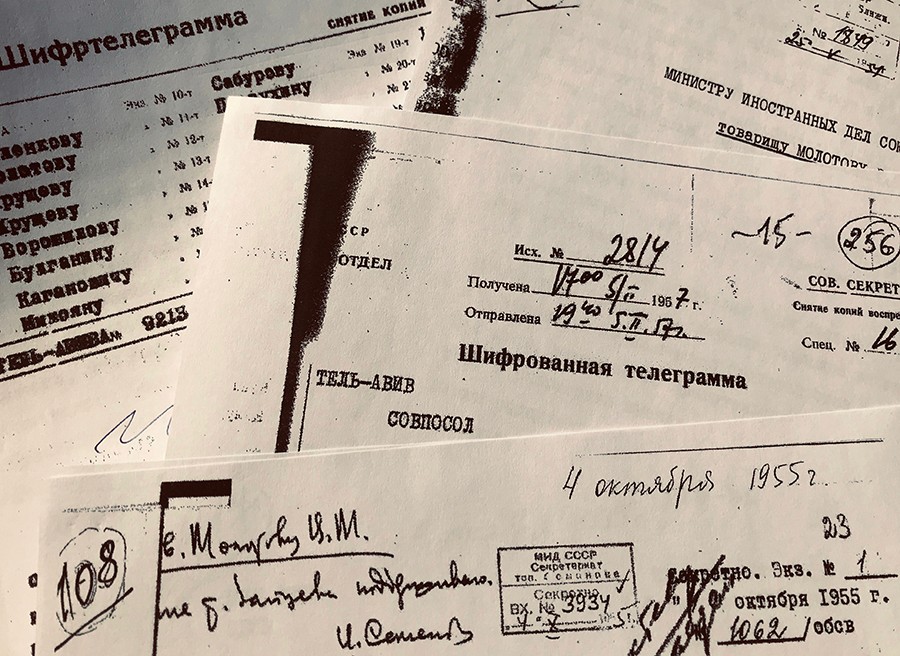
In 2015, a new protocol was signed between the governments of the Russian Federation and Israel for joint work on the publication of the second volume of Soviet-Israeli documents, covering the period from 1954 to 1967. In 2017, work began on identifying and declassifying documents from the diplomatic archives of both countries. In Russia, this work is carried out by a team from the Historico-Diplomatic Department of the Russian Ministry of Foreign Affairs, led by N.M. Barinova; in Israel, it is conducted by a group from the Cummings Center and the Israel State Archives, led by B. Morozov. The number of documents selected for the new publication exceeds 700, including, for the first time, a very large volume of cipher telegrams and "Nativ" documents declassified specifically for this project.
The period from 1954 to 1967 was characterized by the intensification of the Cold War and the struggle for influence in the Middle East, accompanied by active Soviet support for Arab states, the supply of modern weaponry to them, and sharp antagonism in relations with Israel following the 1956 Suez Crisis. Simultaneously, this period saw an active international campaign against the discrimination of Soviet Jewry, organized by Israel, and a constant struggle for the freedom of Jewish emigration from the USSR. The documents prepared for publication should reveal the activities of the "Bar Commission"[33] in organizing this campaign and the reaction of the Soviet leadership, which initiated an active struggle against the Zionist movement. It is hoped that the documents published in the second volume of the project will assist researchers in studying this new phase of the struggle for Aliyah.
Dr. Yakov Livne is an expert on the history of Soviet-Israeli relations and the Zionist movement in the USSR. As a career Israeli diplomat, he has served in the United States, Germany, and Eastern Europe, and headed the Eurasia-1 Department of the Israeli Ministry of Foreign Affairs. He currently serves as Ambassador to Poland.
[1] Moshe Namir, Mission to Moscow: Honeymoon and Years of Wrath, 1948–1950. Tel Aviv: Am Oved, 1971, pp. 293, 59 (in Hebrew); "Zorin on the meeting with Meir, September 14, 1948, secret," The Middle East Conflict. From the Documents of the Foreign Policy Archive of the Russian Federation. 1947–1967. Volume 1: 1947–1956. Ed. V.V. Naumkin. — Moscow: MFD, 2003 [hereinafter — The Middle East Conflict], p. 54
[2] Namir, Mission to Moscow, pp. 64, 293; Shiburin to Zorin, September 22, 1948 — Soviet-Israeli Relations. Collection of Documents [SIR], volume 1, 1941–1953, book 1, No. 170, p. 386
[3] Meeting of Sharett with Deputy Foreign Minister Vyshinsky, December 12, 1948 (SIR, volume 1, No. 205, pp. 436–443. Israel State Archives [ISA], p. 5)
[4] Namir, Mission to Moscow, pp. 251–254; Cabinet meeting, December 29, 1948.
[5] Vyshinsky on the meeting with Meir, January 20, 1949, secret (SIR, volume 1, No. 212, p. 452), Meir to Sharett, January 22, 1949, secret (SIR, volume 1, No. 214, p. 454)
[6] P. Vil’khovoi to N.S. Khrushchev. Report on the work of the UkSSR commissioner of the council for the affairs of religious cults for October-December 1948, 9 February 1949, top secret. Published in: Vladimir Khanin, Documents on Ukrainian Jewish Identity and Emigration (London: Frank Cass, 2003), pp. 87–89.
[7] Oral notes of the USSR Ministry of Foreign Affairs, February 7, 1949 (SIR, volume 1, No. 219, p. 460).
[8] See: Moshe Sharett, Just as Said: Oral Statements on Foreign and Domestic Policy, 1948–1951. Ed. Yaakov and Rena Sharett. Tel Aviv: Moshe Sharett Heritage Society, 2013–2018 (Hebrew). Sharett’s quoted statements: "Information for Mapai Activists, early June 1949" (Vol. 2, 2016, p. 450); "Address to the Knesset Foreign Affairs and Defense Committee, August 8, 1949" (p. 704); and "Address to the Secretariat and Faction of the ruling Mapai party in the Knesset, December 31, 1949" (p. 977)
[9] Bakulin to Shvernik, July 5, 1949, secret (SIR, volume 2, No. 252, pp. 49, 51)
[10] Namir, Mission to Moscow, pp. 290–291. Namir repeated this at the Cabinet meeting on November 22, 1949 — ISA, p. 20; Telegrams from Namir and Livni to Sharett, October 21, 1949 (SIR, volume 2, No. 273, pp. 87–89); Foreign Affairs and Defense Committee, November 9, 1949 (Sharett, Just as Said, Vol. 2, pp. 884–885); Vyshinsky to Yershov, January 9, 1950 (SIR, volume 2, No. 288, p. 119)
[11] Sharett at the seminar of the "HaKibbutz HaMeuhad" movement on "The State of Israel Facing East and West," April 22, 1950 (Sharett 2018, p. 382). Uri Bialer, Between East and West: Israel’s Foreign Policy Orientation 1948–1956 (Cambridge: Cambridge University Press, 1990), p. 73; Yershov to Foreign Ministry, June 19, 1950 (SIR, volume 2, No. 321, p. 188). Foreign Affairs and Defense Committee, September 1, 1950 (Sharett, Just as Said, Vol. 4, 2018, pp. 745, 749)
[12] Yosef Govrin, “The Beginnings of the Struggle for Soviet Jewish Emigration and Its Impact on Israel-Soviet Relations”, in Y. Ro’i (ed.), Jews and Jewish Life in Russia and the Soviet Union (Ilford: Frank Cass, 1995) pp. 327–337. Review of the USSR Ministry of Foreign Affairs on relations with Israel, April 19, 1950, secret (SIR, volume 2, No. 311, p. 163)
[13] Yershov on the meeting with Riftin, September 7, 1950 (SIR, volume 2, No. 329, p. 218)
[14] Gromyko on the meeting with Eliashiv, July 17, 1951, secret (SIR, volume 2, No. 368, p. 274); Eliashiv on the meeting with Gromyko, July 17, 1951 (SIR, volume 2, No. 369, p. 275); Yershov to Foreign Ministry, political-economic report of the mission, August 13, 1951 (SIR, volume 2, No. 373, p. 281); Yershov on the meeting with Eliashiv in Israel, September 3, 1951, secret (SIR, volume 2, No. 378, p. 287); Vyshinsky on the meeting with Eliashiv, September 13, 1951, secret (SIR, volume 2, No. 378, p. 291); Eliashiv on the meeting with Vyshinsky, September 13, 1951 (SIR, volume 2, No. 379, p. 291); Cabinet meeting, October 17, 1951 — ISA, p. 29
[15] Cabinet meeting, November 25, 1951 — ISA, p. 4; Note from the Government of Israel to the Government of the USSR, December 8, 1951 (SIR, volume 2, No. 388, p. 308)
[16] Sharett on the meeting with Vyshinsky, January 6, 1952 (SIR, volume 2, No. 394, p. 314); Cabinet meeting, December 31, 1951 — ISA, p. 28; Vyshinsky to Foreign Ministry, December 23, 1951 (SIR, volume 2, No. 392, p. 314).
[17] "Eliashiv to Sharett, February 1, 1952, secret" (SIR, volume 2, No. 397, p. 330).
[18] "Gromyko to Stalin, February 23, 1952, top secret" (SIR, volume 2, No. 398, p. 335)
[19] Draft letter from the Soviet Foreign Ministry to Deputy Chairman of the Council of Ministers Molotov, April 6, 1952, top secret (SIR, volume 2, No. 404, p. 343)
[20] Yershov to Foreign Ministry, March 21, 1952 (SIR, volume 2, No. 402, p. 341); Report of the mission in Israel for 1951, May 12, 1952, secret (SIR, volume 2, No. 411, p. 352); Soviet Chargé d'Affaires Abramov to Foreign Ministry, June 13, 1952 (SIR, volume 2, No. 412, p. 356); Soviet Chargé d'Affaires Abramov to Foreign Ministry, August 20, 1952 (The Middle East Conflict 103/1, p. 173)
[21] Binyamin Pinkus, Special Relations: The Soviet Union and Its Allies' Relations with the Jewish People, Zionism, and the State of Israel, 1939–1959. Sde Boker: Ben-Gurion Institute, 2007, p. 326
[22] Bialer, Between East and West, pp. 60, 64–65; Ya’akov Ro’i, Soviet Decision Making in Practice — the USSR and Israel 1947–1954 (London: Transaction Books, 1980), p. 143
[23] Bialer, Between East and West, pp. 63, 69; Ro’i, Soviet Decision Making, p. 29; Khanin V. and Morozov B., "Traitors of the Motherland": Aliyah through the Eyes of Soviet Authorities. Tel Aviv: Tel Aviv University Press, 2005, p. 39; Namir, Mission to Moscow, pp. 26, 29, 166
[24] Ro’i, Soviet Decision Making, p. 144; Silin on the meeting with Avriel, August 9, 1948, secret (SIR, volume 1, No. 142, p. 336)
[25] Bialer, Between East and West, p. 69; "Brief description of my visits to military attachés or their visits to me in late September 1948," handwritten note (Ratner, with the military mission to the USSR 1948–1953, file V-1370/17)
[26] Sharett on the meeting with Vyshinsky in Paris, December 12, 1948 (Ministry of Foreign Affairs 1/a, No. 206, p. 414); Meeting of Ben-Gurion with Yershov, December 27, 1948 (SIR, volume 1, No. 208, p. 446)
[27] Diary of Ben-Gurion, March 7, 1949, Ben-Gurion Archive; Cabinet meeting, March 10, 1949 (Sharett, Vol. 2, 2016, p. 302)
[28] Bialer, Between East and West, p. 63; Meeting of Vyshinsky with Meir, April 14, 1949, secret (SIR, volume 1, No. 237, 481); Namir, Mission to Moscow, p. 120; Levavi's document "Israel and the International Arena," June 6, 1949, secret (SIR, volume 2, No. 245, p. 21)
[29] Bialer, Between East and West, pp. 61–65
[30] Ha-Kohen 1994, pp. 323–324; Bialer, Between East and West, pp. 64–65
[31] Yershov to Foreign Ministry, May 25, 1951 (SIR, volume 2, No. 361, p. 258); Levavi's document, July 27, 1951 (SIR, volume 2, No. 372, p. 279)
[32] Ha-Kohen 1994; Bialer, Between East and West, pp. 64–65 — figures rounded to the nearest thousand.
[33] Refers to a group of members of relevant Israeli agencies dealing with the issue.
The views expressed by the experts do not necessarily reflect the official position of the Institute for Euro-Asian Jewish Studies or the Euro-Asian Jewish Congress.