This is an automated translation and may contain inaccuracies. For citation purposes, please refer to the original Russian version.
In recent years, the growing interest of European "new right" parties, such as the Alternative for Germany (AfD), in Russian-speaking Jewish immigrants has become evident. This is despite the group's lack of significant electoral influence in either regional or national politics. The motivation behind this interest lies in the hope of leveraging their connections to establish communication channels with Israel, to counter accusations of antisemitism, and thereby to gain legitimacy within local society and international organizations. For their part, Russian-speaking Jews show considerable sympathy for the slogan championed by the AfD and similar parties, which advocates fighting anti-Zionism and defending Israel's right to exist as the "national home of the Jewish people." It remains to be seen whether this phenomenon represents anything more than a political curiosity or a mere electoral symbol.
Editor's Foreword
Communities of the "Russian-Jewish diaspora," which, by the criteria of the Israeli Law of Return, number approximately three million people, exist today in dozens of countries across five continents. The complex combination of cultural and mental stereotypes, social and economic values, and ideological views characteristic of Jews from the former USSR was formed during the wave of democratic and neo-authoritarian transformations of the late Soviet and post-Soviet eras. In the case of emigrant Jews, these views were shaped both by ideas brought from their countries of origin and those absorbed within their new social environments. In both cases, this phenomenon was bound to find political expression. In those Western countries where "Russian" Jews obtained citizenship, the political sympathies of the majority typically stabilize within the center-right segment of the party-political spectrum (be it right-liberal or moderate-conservative, depending on the local ideological and political tradition) after 6 to 7 years of successful adaptation. [1]
However, unlike in Israel, where immigrants from the former USSR often determine the outcome of election campaigns, and to some extent, very specifically, in the US, other Russian-speaking Jewish communities do not, at first glance, possess such influence. In the post-Soviet space, as well as in countries like Germany, Austria, and Canada, "Russian-speaking" Jews carry significant, sometimes even decisive, weight within the internal politics of local Jewish communities and their umbrella organizations. Yet, on the national political stage, the presence of this group as a politically organized community is barely felt. Nonetheless, even the isolated presence of its representatives among party activists, while not a factor capable of shifting the balance of political power in the country, is increasingly perceived as an important political phenomenon that should not be ignored. [2] In Germany, examples of this include Sergey Lagodinsky, who initiated the creation of a "Jewish Social Democrats" group within the Social Democratic Party of Germany in 2007, and the members of the "Jewish cell" of the right-wing Alternative for Germany party in Wiesbaden. The question remains whether there is more to this phenomenon than a political curiosity or a simple electoral symbol. This is the subject of the article by EAJC expert E. Yakimova.
Prof. Ze'ev Khanin, Chairman of the Academic Council of the Institute for Euro-Asian Jewish Studies
Russian-Speaking Jewry in the Political Life of the FRG
The Alternative for Germany party was founded in 2013, with its initial platform focusing primarily on the negative aspects of introducing the single European currency and opposing the bailout of weaker EU economies by stronger players, particularly Germany itself. Over time, the focus shifted to the migration crisis, in which the AfD took a hardline stance on immigrants, representing the exact opposite of the course pursued by Federal Chancellor A. Merkel. Emphasizing the threat posed by immigrants from the Middle East, including the Islamization of the country, combined with attempts to secure a total ban on the Lebanese Shiite group Hezbollah through the Bundestag, did not bring the party the desired rapprochement with Israel. This was largely due to statements by several of its activists who called for a revision of the status of the Holocaust in German history.
Despite its controversial reputation, the Alternative for Germany was still able to carve out a distinct niche in the country's modern politics by uniting within its program the needs of various segments of the population, from East Germans to the so-called "late resettlers" from the former USSR. Russian-speaking Jews from the post-Soviet space became a distinct category of the electorate of interest to the AfD. The interest in them is driven by several factors. First, through transnational ties within Russian-speaking Jewry, they could potentially facilitate the establishment of communication channels with Israel. Second, the similarity of several challenges faced by "Russian" Germans and "Russian" Jews in Germany allows for policy toward these two segments to be structured along a similar model. Finally, the AfD's engagement with the Jewish theme is significantly complicated by opposition from the country's largest community organizations, to which Russian-speaking Jews—who have never fully integrated into that environment—represent a kind of alternative.
Intra-Party Associations of the AfD and Russian-Speaking Jews in Germany
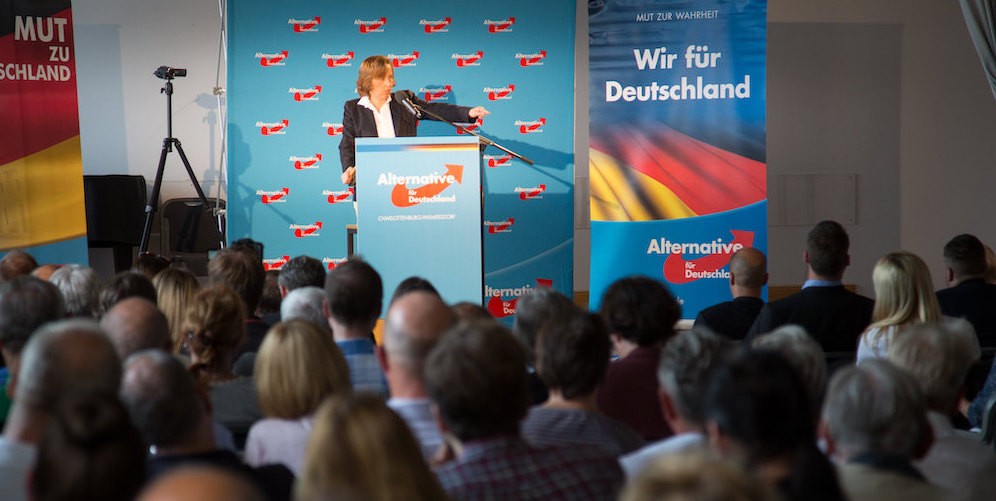
On October 7, 2018, in the city of Wiesbaden (Hesse), the intra-party association "Jews in the AfD" was established, with its primary stated goal being the fight against antisemitism. This event triggered a wave of criticism among Jewish organizations in the FRG, most notably from the Central Council of Jews in Germany. The main objection of skeptics was that by "playing" with the Jewish theme, the party was attempting to soften accusations of right-wing antisemitism and a revisionist approach to the Holocaust, which had been repeatedly leveled against it[3]. Another point of contention was the interest in Russian-speaking German Jews, evidenced by the fact that approximately one-third of the new association's participants belonged to this group[4].
Prior to this, the Alternative for Germany already had experience in establishing similar intra-party groups. One of them was the association of Russian-speaking Germans supporting the AfD. It was founded in 2016 in the state of North Rhine-Westphalia with two goals: to disseminate the party's ideology among the potential electorate and to prove that the AfD supports immigration if the newcomers are capable of successful integration, as the "Russians" did[5]. The backdrop for the establishment of both associations was reports of crimes committed against teenage girls from Russian-speaking families by individuals from the Middle East who had applied for refugee status in Germany.
Another group is the "Christians in the AfD," although it would be more accurate to call them the first intra-party association, as it was established in 2013 and is currently the most widespread of those mentioned. Its list of objectives also appears to be the most extensive. Among them are points that allow for certain parallels with "Jews in the AfD," namely the call to protect traditional values, including family and marriage, as well as the Islamic threat rising in Germany with the influx of immigrants from the East, where representatives of other religions are persecuted in their home countries[6].
The AfD Program and the Demands of Russian-Speaking Jews in Germany
Experts from the Institute for Euro-Asian Jewish Studies have already addressed various aspects of the life of Russian-speaking Jews in Germany,[7] so there is no need to dwell on them in detail. Let us only recall that the host society, which once supported the idea of attracting immigrants from the former USSR/CIS in the hope of reviving community life, now levels criticism against them related to insufficient religiosity as well as incomplete integration, including language and cultural barriers. In the context of the Alternative for Germany's activities aimed at Russian-speaking Jews in the FRG, it is noteworthy that the party attempts to address many areas where conflict exists between the host society and the immigrant group.
First, the AfD addresses the religious component, emphasizing that Jewish identity is not only a matter of faith but also a shared tradition, understanding, and respect for the history of one's people[8]. This is perhaps an answer to one of the main dilemmas faced by Russian-speaking Jews in Germany, who arrived in the country on the basis of their Jewish roots, usually documented by Soviet papers containing a nationality field. However, upon arrival, it turned out that the key aspect defining Jewish identity was religion. The AfD, in turn, proposes a comfortable alternative where the ethical principles of Judaism are prioritized. Thus, Russian-speaking Jews are in a sense offered a reconstruction of the environment familiar to those who lived in the USSR, where Jewish life was absent, but which did not preclude performing certain rituals or rules in whatever form was accessible.
In the thematic block of the party platform, there is also a visible emphasis on family values, which aligns the programs of "Jews in the AfD" and "Christians in the AfD." However, there are a number of significant differences, such as the approach to religious education. Thus, in the latter case, mention is made of teaching the history of religion, through which students should gain an understanding of the role of Christianity in Western culture, while in the address to the Jewish population, such a point is absent[9]. Furthermore, speaking of traditional family values, which, judging by the party's publications, both mentioned communities share, it is still notable that the platform of "Christians in the AfD" places a significantly stronger emphasis on the traditional family and the rejection of homosexual relationships[10].
Language policy is closely linked to cultural matters, and an evaluation of it reveals one significant difference between the intra-party associations targeted at Russian-speaking Jews and Russian-speaking Germans. In building a dialogue with the latter, the AfD emphasizes the need to publish information in two languages, explaining this by the complexity of political terminology[11]. In the case of "Jews in the AfD," the party strives to pursue a more universal course, thereby demonstrating that it is actually attempting to articulate the interests of voters within the German Jewish community as a whole, rather than focusing on its individual segments. Furthermore, in this case, the party aligns itself more with the opinion of the country's "indigenous" Jewish population, which objects to the active use of the Russian language in the German Jewish press and at cultural events.
The second important thematic section of the party platform for the "Jews in the AfD" association lies in addressing institutional foundations. Thus, the program states that the format of traditional community organizations has virtually outlived its usefulness, as it forces their members to align not with their own needs but to submit to sponsors. Therefore, according to the party, a suitable alternative is to unite precisely around the group created within its ranks[12]. In part, this also resonates specifically with the interests of Russian-speaking Jews in Germany, whose participation in community structures is a source of many disagreements, including the already mentioned religious and linguistic aspects.
However, the option proposed by the AfD has its drawbacks. These lie in the fact that an intra-party association is incapable of providing the same level of social support as community structures. The latter, despite the tensions between "Russian-speaking" Jews and the country's "indigenous" Jewish population, do a great deal precisely to support the former. This is especially true for older generations. The AfD, in turn, offers instead a more effective representation of community interests in government bodies. However, the party's existing resources for this are currently insufficient; despite successes at the state level, there remains serious opposition to its influence in central government bodies.
Moreover, the question of the language barrier arises again here, since the majority of social assistance recipients are older Russian-speaking Jews for whom communication in German is difficult. Consequently, the party must create a separate line of work for them or direct them toward the more accessible association of Russian-speaking Germans. However, in that case, the AfD would not escape accusations that it poses a threat to Jewish community life by promoting assimilation.
The Alternative for Germany's attention to the country's Jewish community organizations may be partly due to the presence within their ranks of supporters of admitting refugees from the East to the FRG, who are ready to provide support in this regard[13]. At the same time, as a basis for this kind of activity, they suggest utilizing the accumulated experience of integrating Russian-speaking Jews from the former USSR. Such an initiative was put forward, for example, by the main umbrella organization of Jewish charitable and social structures, the Zentralwohlfahrtsstelle der Juden in Deutschland (ZWST), which cooperates with human rights activists overseeing the rescue of refugees in the Mediterranean. In justifying this kind of activity, the leadership of ZWST cites the possibility of thereby curbing the radicalization of immigrants arriving in Europe, while mentioning the opposing activities of the AfD[14].
The most crucial topic in the "Jews in the AfD" program remains antisemitism. It is examined in two aspects. The first of these is the threat posed by immigrants from Eastern countries raised in traditions of hatred toward Jews[15]. This is quite understandable rhetoric, given the party's anti-migration policy, but in the context of the challenges faced by Russian-speaking Jews in the FRG, it sounds highly contradictory, as this segment of the country's Jewish population is often accused of spreading this stereotype, which is based on the priorities of Soviet policy in the Middle East[16].
The second aspect of antisemitism is the fight against anti-Zionism. Within this framework, the Alternative for Germany declares not only the need to defend Israel's right to exist, based on Germany's special responsibility toward Jews after the Holocaust, but also the understanding of Israel as the "national home of the Jewish people"[17]. Based on the premise that the state also represents the interests of the diaspora, i.e., the Jews of the FRG themselves, it likewise requires support. Interestingly, in this point, the party returns to its origins for perhaps the first time, i.e., it addresses the economic component of the problem, emphasizing the erroneousness of the federal government's policy of funding UNRWA.
Overall, while the program offered by the Alternative for Germany contains a sufficient number of aspects that align with the interests of the Russian-speaking Jewish population of the FRG, it would be incorrect to assume that the party as a whole, or its "Jews in the AfD" association in particular, is focused solely on them. The primary goal of the AfD is to attract the votes of all representatives of German society who, guided by various reasons, do not support the current government's course. Among them, of course, are immigrants from the former USSR/CIS, and not only of Jewish origin. However, within the same milieu, there are also opponents of this party. Associating all Russian-speaking Jews in Germany with the AfD is more of a factor that fuels general criticism of them in the conflict that has arisen in the process of integrating newcomers into society and Jewish community structures.
[1] Vladimir Khanin, “The New Russian Jewish Diaspora and “Russian” Party Politics in Israel”, Nationalism & Ethnic Politics, Boulder, Vol. 8, No 4 (December 2002), pp. 54-81
[2]Vladimir (Ze’ev) Khanin, “Die Diaspora russischsprachiger Juden Politische Einstellungen und Einfluss” (The Russian-speaking Jewish Diaspora: Political Attitudes and Influence) in Manfred Sapper, Volker Weichsel (Eds.), Migration, Identität, Politik. Trans-inter-national: Russland, Israel, Deutschland (Migration, Identity and Politics: Trans-, Inter- and National: Russia, Israel and Germany). Berlin: Special Issue of Osteuropa, 9–11/2019, pp. 123-139, in German
[3] Gemeinsame Erklärung gegen die AfD. Zentralrat der Juden in Deutschland. URL: https://www.zentralratderjuden.de/fileadmin/user_upload/pdfs/Gemeinsame_Erklaerung_gegen_die_AfD_.pdf
[4] Vereinigung “Juden in der AfD” gegründet. Jüdische Allgemeine. 07.10.2018. https://www.juedische-allgemeine.de/politik/vereinigung-juden-in-der-afd-gegruendet/
[5] Netzwerk Russlanddeutsche in der AfD gegründet. Russlanddeutsche für AfD NRW. URL: https://russlanddeutsche-afd.nrw/aktuelles/2016/03/netzwerk-russlanddeutsche-in-der-afd-gegruendet/
[6] Wofür steht ChrAfD? Christen in der AfD. URL: https://www.chrafd.de/index.php/grundsatzerklaerung
[7] See, for example: Khanin Z.
The views expressed by the experts do not necessarily reflect the official position of the Institute for Euro-Asian Jewish Studies or the Euro-Asian Jewish Congress.
