This is an automated translation and may contain inaccuracies. For citation purposes, please refer to the original Russian version.
Academic journals in the field of Jewish studies in the post-Soviet states have existed for nearly 30 years, in some cases with considerable success. The history of their development can be divided into four periods: the first half of the 1990s; the late 1990s to the 2000s; the first half of the 2010s; and from the mid-2010s to the present. The roundtable discussion of editors of Jewish academic periodicals held in February 2013 demonstrated the demand for this genre from both the public and the academic community, as well as the necessity of their independent existence (free from grants, and the whims of sponsors and publishing houses) under the auspices of universities and research institutes. Today, this is extremely difficult to achieve given the common challenges faced by post-Soviet countries, such as the crisis in the humanities, the outflow of personnel from academic science and higher education institutions, the brain drain abroad, and political conflicts in the post-Soviet space. Nevertheless, the current state of Jewish academic journals helps sustain the system of Jewish studies and the teaching of Jewish disciplines in higher education in post-Soviet countries that emerged in the 1990s.
In the discussion on the Jewish press in the post-Soviet states on the Institute's website (Velvl Chernin's articles "The State of Jewish Periodicals and Book Publishing in the Former USSR," Euro-Asian Jewish Policy Papers, No.33, and Ze'ev Khanin's "Are Jewish Publications Needed in the Former USSR: Sociological Aspects," Euro-Asian Jewish Policy Papers, No.34), colleagues did not address one aspect: Jewish academic periodicals. Although some authors, such as S. Charny, V. Mochalova, and others, including the author of these lines, have already begun to summarize the development of Jewish studies in the post-Soviet period, little attention is paid to the role and place of academic journals in the establishment of Jewish studies in Russia and post-Soviet states. Yet they have existed for almost 30 years, in some cases quite successfully. Below, the author will present a brief overview of what has occurred with Jewish (in the sense that the journals are dedicated exclusively to Jewish studies) academic periodicals in recent decades. The author has endeavored to make this review as objective as possible, though some personal assessments may be present—the author has been involved in editing a Jewish academic journal for 10 years and has long been close to the academic sphere.
When discussing academic periodicals, two important points are worth noting. First, any academic journal is, on one hand, a snapshot of the state of the discipline and, on the other hand, a force shaping trends in the represented field of research. Second, if a journal was established from scratch, without links to the old academic publications of the Soviet period, then the creation of each such journal represents immense, sometimes monumental, effort to find its own niche, formulate editorial policy, secure funding, organize the editorial board, and, finally, edit the submitted materials. Thus, during the entire thirty-year period, any of these publications resolved three tasks: defining trends in Jewish studies in a given territory, providing a platform for academic discussion, and attempting to gather like-minded researchers around them.
Four stages can be distinguished in the development of academic periodicals in Jewish studies after 1991.
Stage 1: The First Half of the 1990s.
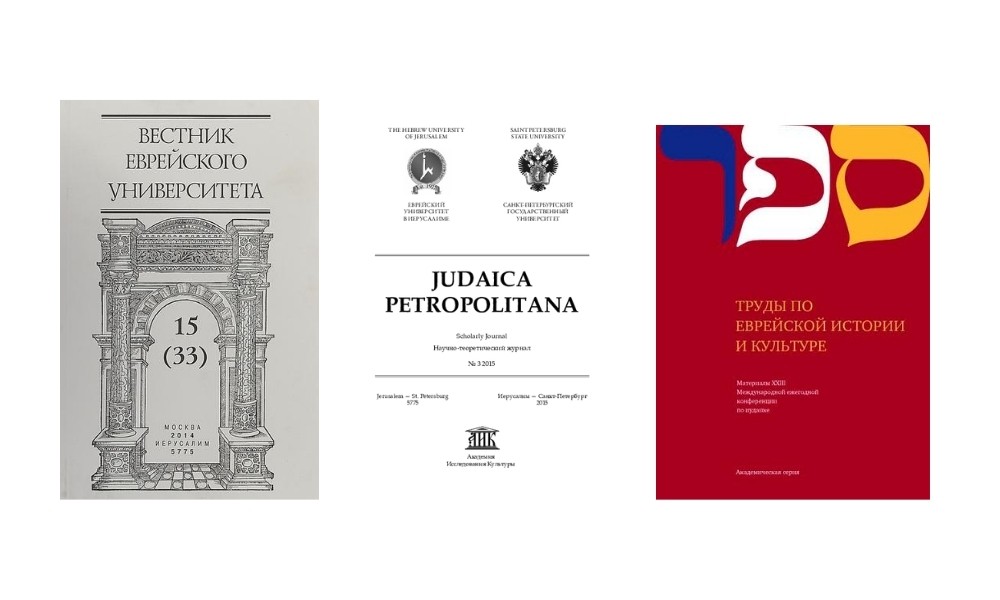
The first journal, both chronologically and in terms of the scope of topics, authors, and events, was the "Bulletin of the Jewish University in Moscow," which appeared in 1992. Its editors initially declared that the publication needed to be transformed into a "coordinating center" for post-Soviet Jewish studies. The journal was published regularly, which is why for a long time it became the sole opportunity to publish original works on Jewish history and culture, and served as a window of sorts into Jewish studies. In 1998, the "Bulletin" acquired a new name: "Bulletin of the Jewish University: History. Culture. Civilization," and slightly modified its format, more frequently offering translations of works by Israeli authors.
Changes in the editorial board and editorial policy were linked to the involvement of the Hebrew University of Jerusalem and the Center for Jewish Studies and Jewish Civilization of the Institute of Asian and African Studies of Moscow University, established in the same year, 1998. From the mid-2000s, the "Bulletin" began to appear irregularly, and in 2011 its publication ceased entirely. The history of the "Bulletin" was already described by the Russian researcher S. Charny in 2009, and it seems impossible to add anything further to that for now. In any case, throughout the entire period of 1992–2011, the "Bulletin" provided a comprehensive picture of what was happening in academic Jewish studies in the Russian-speaking space. Gradually, as Jewish studies grew stronger as an independent academic field in the post-Soviet territory, other academic publications began to appear.
Stage 2: The Late 1990s – 2000s.
The peak of the emergence of Jewish academic periodicals occurred in the late 1990s and lasted until the second half of the 2000s. In fact, the turn of the 1990s and 2000s was the golden age of Jewish studies. Several significant factors contributed to this: on one hand, the intensification of Russian-Israeli relations, including in the field of science, and on the other hand, the enthusiasm of researchers, the influx of sponsor money, and the interest of young people (students, graduate students) in studying the subject, as well as the general atmosphere of constantly held conferences, schools, internships, and other educational projects of the "Sefer" Center for University Teaching of Jewish Civilization. All this distinguished Jewish studies favorably from other fields of knowledge associated with a particular region or country—no such boom was observed in Indology or Arabic studies, for instance.
Figures of the Jewish movement formulated a theory according to which schools and universities were to become the guarantee of the revival of the Jewish community in secular post-Soviet society. It should be noted that this theory still dominates the Jewish movement in post-Soviet Russia, and is even supported by empirical evidence.
Logically, under such conditions, the number of Jewish academic publications grew. Furthermore, Jewish topics frequently appeared in general academic journals, such as the Russian "Vostok (Oriens). Afro-Asian Societies: History and Modernity," "Zhivaya Starina," and "Diasporas," the Moldovan Revista de etnologie şi culturologie, as well as in popular-science and literary Jewish magazines (the Moscow-based "Lekhaim," the Kyiv-based "Yehupets," etc.). This testified to the interest in Jewish studies not only from scholars but also from the general public. Moreover, this period marked the beginning of a general trend that clearly continues to this day: the desire to integrate Jewish history and culture into a broader context of research in which authorities, scholars, and societies in post-Soviet states were interested.
This process, as can be observed, captured not only Russia but also other countries of the former USSR, where their own Jewish academic publications appeared at the same time. Thus, in 1997, the collection "Jews of Belarus. History and Culture" began to be published. Six volumes were issued (the last in 2001), after which publication ceased due to lack of financial resources. In 2002–2004, the publicist and activist of the Jewish movement Ya. Z. Basin prepared the collections "Belarus in the XX Century," and in 2007, together with the Belarusian historian I. N. Kuznetsov, published three volumes of the books "Repressive Policy of Soviet Power in Belarus." The Jewish theme occupied a major part of these two serial publications by Ya. Basin.
In Ukraine, where Jewish studies experienced a particular rise in the 1990s and 2000s, a general academic journal on Jewish studies was not created at that time: only specialized academic periodicals were published, such as "Holocaust and Modernity. Studies in Ukraine and the World," published by the Ukrainian Center for Holocaust Studies (the first issue was released in 2005, the next in 2007, and since 2008 it has been published regularly), and "Problems of Holocaust History: Ukrainian Dimension," published by the Ukrainian Institute for Holocaust Studies "Tkuma" (the first issue appeared in 2002; by 2018, eight issues and a 2019 English digest had been published; edited by I. Shchupak).
Special mention should be made of the collection/journal "Tirosh: Studies in Judaica," which began to be published in 1998 under the publishing program of the "Sefer" Center (in 1997 it was released as a collection of materials of the First Youth Conference of the CIS on Jewish Studies). Since 2018, "Tirosh" has been printed as a full-fledged academic periodical under the title "Tirosh: Studies in Judaica, Slavic and Oriental Studies." The collection originally positioned itself as a publication for young people, which partly ensured its success. In general, the immense achievement of its creators was that "Tirosh" became a launching pad for many (if not most) researchers currently working in the field of Jewish studies and Middle Eastern studies. I will note one more detail that characterized "Tirosh" positively: the youth collection of the "Sefer" Center has been published regularly all these years.
Another attempt to create a full-fledged academic journal on Jewish studies was made by the Lithuanian Center for Studies of the Culture and History of East European Jews, established in 2004. Since 2006, the Center has published several issues of the journal Pinkas (published in English), but in 2010, with the third issue, publication was suspended.
Difficulties with the publication of academic journals began in the second half of the 2000s. It can be said with certainty that this was a trend characteristic of all Central and Eastern Europe: for example, the Central European University publication Jewish Studies at the CEU appeared very rarely, although it was called a yearbook; in 2008, the publication of the Israeli journal Jews in Russia and Eastern Europe was discontinued; the "Bulletin of the Jewish University," which remained the primary academic periodical for post-Soviet states, began to appear irregularly. In Belarus, the seventh volume of the collection "Jews of Belarus. History and Culture" was never published, although the materials for this issue were nearly compiled, and Ya. Z. Basin's publications did not appear after 2007. After 2010, Pinkas ceased publication; only the aforementioned Ukrainian journals covering various aspects of Holocaust history—"Holocaust and Modernity. Studies in Ukraine and the World" and "Problems of Holocaust History: Ukrainian Dimension"—appeared more or less regularly.
Stage 3: The First Half of the 2010s.
Consequently, those scholars who continued to engage in Jewish studies began to recognize the need for new specialized publications in the field. In 2008, the Ukrainian art historian E. A. Kotlyar began editing special issues of the "Bulletins of the Kharkiv State Academy of Design and Arts" ("Вісник Харківської державної академії дизайну і мистецтв"), which contained materials on Jewish art. In 2010–2011, he succeeded in publishing issues completely dedicated to Jewish art in Ukraine. In 2009, the publication of the collection Mizreh. Jewish Studies in the Far East (edited by B. Kotlerman) began in Birobidzhan (I am aware of two issues published in 2009 and 2011, and apparently, no more issues appeared). In 2010, the author of these lines was fortunate to establish the yearbook Tsaytshrift / Časopis ("Journal," or "Chronicle," by analogy with the Yiddish publication prepared in 1926–1931 by the Jewish section/department of the Belarusian Academy of Sciences); the journal continues to exist to this day. The trend of establishing specialized academic journals continued in the 2010s: since 2011, the "Collections of Scientific Works of the Institute of Jewish Studies" were published in Moldova (currently discontinued); in 2012, the Kyiv-Mohyla Academy published two issues of the journal Judaica Ukrainica; in 2013, the Department of Jewish Culture of Saint Petersburg University, with the support of the Hebrew University of Jerusalem, published the first issue of the journal "Judaica Petropolitana" ("Petersburg Judaica").
In February 2013, at the XX International Conference on Jewish Studies in Moscow, the "Sefer" Center and the editorial board of the yearbook "Tsaytshrift" / "Chasopis" organized a roundtable of editors of Jewish academic periodicals, attempting to gather all publications concerning Jewish themes and related to science at that time (present were editors of the journals "Bulletin of the Jewish University" (Moscow), "Bulletin of the Kharkiv State Academy of Design and Arts. Oriental Studies" (Kharkiv), "Diasporas" (Moscow), "Zhivaya Starina" (Moscow), "Narod Knigi v mire knig" (Saint Petersburg), "Archive of Jewish History" (Moscow), "Euro-Asian Jewish Yearbook" (Moscow – Kyiv), Pinkas (Vilnius), Tsaytshrift/Časopis (Vilnius), as well as the Swedish journal "Central Asia and the Caucasus," the Polish "Cwiszn," D. B. Kerler's "Jerusalem Album," the "Tirosh" collections, annual collections of "Sefer," and serial publications—the Moscow-based Judaica Rossica and the St. Petersburg-based "Proceedings in Jewish Studies"). This meeting of editors demonstrated the demand for Jewish academic periodicals, as well as the necessity for independent academic publications—independent of grants, or the whims of sponsors and publishing houses. This meant that such publications should be issued by academic institutions (universities, research institutes).
Stage 4: From the Mid-2010s.
Time passed, but the demand for academic periodicals in Jewish studies remained, despite the fact that Jewish studies itself was experiencing a crisis (the Ukrainian researcher V. Likhachev in 2012 raised the question of a possible "systemic error" in the development of Jewish studies). The causes of the crisis were primarily the challenges common to post-Soviet countries: the dead-end state of the humanities, which proved to be in no demand from the state; this, in turn, led both to the internal outflow of personnel from academic science and higher education institutions to other sectors (for example, business), and to the "brain drain" beyond the borders of the post-Soviet territory. These same processes in Jewish studies were exacerbated by the lack of sponsor money, which was particularly felt after the global economic crisis of 2008. V. Likhachev pointed to another problem: the lack of interest of the community leadership in fully involving young people in community activities.
One more factor can be mentioned that significantly influenced the current state of Jewish studies in post-Soviet countries: the international crisis of 2014, which to a certain extent separated Ukrainian researchers from Russian ones. The result of this was the existence of two centers of Jewish studies (in the post-Soviet territory) with little connection to each other—Russia and Ukraine, although prior to 2014 contacts were quite active (however, this is rather the author's personal perception, though hardly anyone would outright deny the impact of these events on the state of Jewish studies in the post-Soviet period).
Thus, from the mid-2010s, the system of academic institutions and publications in Jewish studies that had been built since the 1990s partially crumbled, partly due to political reasons. However, at the same time, it seems that the preservation of the system of academic Jewish studies established in the post-Soviet states is supported precisely by the active "thick" (or not always thick) Jewish academic journals.
Thus, to date, there are seven academic journals dedicated exclusively to the Jewish theme: "Tirosh: Studies in Judaica, Slavic and Oriental Studies" (since 1997) and the Judaic-Slavic Journal established in 2018 (published by the "Sefer" Center) (in Moscow), Judaica Petropolitana (Saint Petersburg), Judaica Ukrainica, "Holocaust and Modernity. Studies in Ukraine and the World" and "Problems of Holocaust History: Ukrainian Dimension" (in Ukraine), and the Belarusian Tsaytshrift / Časopis (in Vilnius). All of them have an International Standard Serial Number (ISSN), and materials submitted to the editorial offices of the journals are peer-reviewed; the Russian and Belarusian-Lithuanian Tsaytshrift / Časopis are included in various academic databases. In addition, almost all journals are freely accessible on the Internet. The presence of these four indicators allows us to speak of a full-fledged academic journal. (The author defined accessibility as one of the main indicators of an academic journal, since scholars in post-Soviet countries are not burdened with funding, which means that following the publications of colleagues is easier with open access to information.)
I deliberately do not mention inclusion in the Web of Science (WoS) and SCOPUS databases as an indicator of the quality of an academic journal (any journal): from the very beginning, these databases were designed for natural sciences in the West and for commercial profit, and in the post-Soviet reality they turned into an indicator of poor academic management, and in some places even into a means of getting rid of dissenters in the academic community. (Unfortunately, academic and university administration throughout the post-Soviet space has forgotten that authors in the humanities—in history, political science, philology, and Oriental disciplines—have always had their own indicators of publication prestige, which are far removed from WoS and SCOPUS).
Assessing the results of the development of Jewish academic periodicals, I can add (although this will be a personal but well-founded opinion of the author of this article) that the best attempts to create Jewish academic periodicals were the Moscow-based "Bulletin of the Jewish University," which was at that time the only academic journal in Russian, and "Tirosh," which paved the way for young researchers; the Ukrainian "Bulletin of the Kharkiv State Academy of Design and Arts. Oriental Studies" (published in 2008–2011) edited by E. Kotlyar, and the Lithuanian Pinkas, published in English—the language of modern science; specialists in the history of the Holocaust highly rated the Ukrainian "Holocaust and Modernity" and "Problems of Holocaust History: Ukrainian Dimension."
It is too early to draw conclusions and make assessments regarding the Moscow-based Judaic-Slavic Journal—only two issues of the journal have been released so far. The St. Petersburg-based Judaica Petropolitana dedicates many materials to the elite problems of Jewish philosophy (however, a review of the 1st issue of Judaica Petropolitana was published by the editors of Tsaytshrift / Časopis (vol. 9(4), pp. 208–209)). Judaica Ukrainica became a journal capable of uniting the scattered forces of Ukrainian researchers, and this became even more necessary after 2014. But this journal, like two other highly specialized ones dedicated to the Holocaust, is focused mainly on Ukrainian-Jewish issues in all their diversity—all of this limits both the circle of authors and the variety of topics; in addition, at present, not all issues of the journal Judaica Ukrainica are freely accessible. Regarding the Belarusian-Lithuanian yearbook Tsaytshrift / Časopis, the author will modestly remain silent for now.
In any case, it makes sense to repeat: the current situation with Jewish academic journals allows the preservation of the system of Jewish studies as a science and the teaching of Jewish disciplines in higher education, a system that took shape in the 1990s in post-Soviet countries. Existing academic journals in the field of Jewish studies reflect the current state of the discipline—focusing on issues relevant to a specific region or a specific academic institution.
A colleague with whom the author discussed some of the conclusions of this article raised a reasonable question: are there any prospects or options for the development of the current situation with Jewish academic periodicals?
This article deliberately excludes serial publications, such as the "Proceedings in Jewish Studies" of the Petersburg Institute of Jewish Studies, the recently appeared "Proceedings of the Department of Jewish Studies" (only two books have been published so far, in 2015 and 2018), materials of annual conferences held by the "Sefer" Center, or collections published following conferences held at the Kyiv Institute of Jewish Studies. All of them, and especially the publications of the "Sefer" Center, had a huge impact on the formation of the academic environment, community education, and the shaping of Jewish identity (on the latter, see the article by Baulina and Khanin "Non-Jewish Zionists: The Experience of the CIS and Baltic Countries" in the EAJC yearbook Jews of Europe and Asia: State, Heritage, and Prospects for the year 5779-2018/2019). Finally, they became a unique snapshot of the development of post-Soviet Jewish studies in the 1990s and 2010s. However, the author is referring exclusively to "thick" academic journals, the idea of creating which, as can be understood from this article, was approached in one way or another by many researchers at about the same time—after the 2010s.
If we characterize the prospects of academic journals specifically, then—it is obvious—they cannot exist without funding. In this regard, there are several possibilities for their further financial existence.
Option 1. Funding from major Jewish foundations. This path still works, but the financial situation is such that international Jewish grant-making foundations currently fund any academic publications infrequently and reluctantly.
Option 2. Funding from the community. The idea of the late 1980s and early 1990s of turning schools, universities, and academic (or rather, academic-organizational) institutions into centers of Jewish communities continues to exist and, apparently, will work for some time. Its adherents are most figures of the Jewish movement of the post-Soviet period. But an academic journal will not become the center on which community life can be built, and the communities themselves will not provide money for academic publications, both because of a lack of their own funds (they themselves largely exist on sponsor donations) and because of the lack of return from any scientific projects: humanities (and social science) are always unprofitable and yield no dividends or bonuses. That is, the second option is, in general, a dead end.
Option 3. Funding from a university or academic institute. An academic journal can be published exclusively under the roof of a university or academic institute and with their funding. Otherwise, the transformation of an academic publication into a publicist or literary one is guaranteed. This is neither bad nor good; it is simply a different genre. The purpose of academic periodicals is to present research results (interim or final) in such a way that they are accepted by the academic community, domestic (and the entire post-Soviet) and foreign—other researchers of Jewish studies, researchers working in related fields, the Higher Attestation Commission (no matter which country), and university authorities. The mentioned seven publications still fully realize this goal. That is, the third option is the most correct, but in post-Soviet realities, funding for a publication from the state / university / academic institute may cease at any moment.
In the end, over time, there may be even fewer of these publications. And the two most important reasons for this are the lack of money and the general reluctance of post-Soviet states to support Jewish studies (the situation differs in different post-Soviet territories, but the general trend is the same). In any case, whatever happens next, all the publications mentioned in the article have already written themselves into the history of the Jewish press in post-Soviet realities.
The views expressed by the experts do not necessarily reflect the official position of the Institute for Euro-Asian Jewish Studies or the Euro-Asian Jewish Congress.