This is an automated translation and may contain inaccuracies. For citation purposes, please refer to the original Russian version.
Photo sources: EAO Newspaper, Obzor Newspaper, Virtual Exhibitions
Abstract. Despite the completed language shift of Eastern European Jewry (the transition from their ethnic language, Yiddish, to Russian) and the consolidation of Russian-speaking Jewry into a distinct ethnolinguistic group within the Jewish nation, Yiddish literature remains a significant factor in their identity. Furthermore, Russian-speaking Jews currently play a leading role—both creatively and organizationally—in Yiddish literature as a whole. Concurrently, Yiddish and the culture created in it within Israel and the Jewish Diaspora symbolize neither the Russian nor the Israeli component, but specifically the Jewish element within the contemporary multi-layered identity of Russian-speaking Jewry.
Despite the completed language shift of Eastern European Jewry (the transition from their ethnic language to another, specifically from Yiddish—which is spoken at least partially by less than 10% of this group—to Russian) and the consolidation of Russian-speaking Jewry into a distinct ethnolinguistic group within the Jewish nation, Yiddish literature remains a significant factor in their identity. Furthermore, Russian-speaking Jews currently play a leading role—both creatively and organizationally—in Yiddish literature as a whole. It appears possible to identify three primary reasons for this phenomenon:
Historically, Eastern Europe, where Russian-speaking Jewry emerged and partly continues to reside, was for many generations the region with the highest concentration of Ashkenazi Jews, where they constituted a notable percentage of the population. Most Yiddish folklore originated in Eastern Europe and was initially subject to significant Slavic linguistic influence. Modern Yiddish literature was likewise created during the 19th and first half of the 20th centuries in Eastern Europe or by emigrants from the region. Consequently, it was from its inception deeply connected both to oral Slavic languages and to Russian-language literary production, including Russian-Jewish literature.
Accordingly, Eastern Europe is perceived even by contemporary Yiddish writers who have never been there and do not speak Slavic languages as the collective "Old Home" of Eastern European Jewry and the virtual homeland of Yiddish literature (it suffices to mention the title of the popular quadrilingual—English, Polish, German, and Hebrew—website of the Museum of the History of Polish Jews, "Virtual Shtetl", which provides information not only on the history of Jewish communities in modern Poland, but across virtually the entire territory of Eastern Europe).
This circumstance essentially positions Yiddish writers born in the former USSR as the "natural successors" to the literary traditions of Eastern European Jews. The perception of their Yiddish writing as uniquely "authentic" stems from the fact that they were born and raised "on the ashes" of the Eastern European Ashkenazi civilization destroyed by the Holocaust, rather than in the countries where Eastern European Jews settled during the mass emigration of the late 19th and first half of the 20th centuries. This circumstance manifests itself both in the language and the themes of their works.
However, this article does not concern natives of Eastern Europe as a whole, but specifically those from the former USSR. Therefore, in addition to the more emotional than practical perception of Eastern Europe as the virtual homeland of Yiddish literature, the specific nature of Soviet ethnolinguistic policy regarding Jews is of paramount importance. While the Soviet authorities' attitude toward Yiddish fluctuated between active support and suppression or gradual displacement, their attitude toward Hebrew was openly hostile from the outset. By the late 1920s, this led to the elimination of any legal avenues for continuing literary work in Hebrew or studying it within the USSR. This transformed Yiddish literary creation, in the words of Chone Shmeruk, into "the only avenue of national self-expression available to Soviet Jews," cementing its role as an important factor in the national identity of Soviet and post-Soviet Jews who no longer spoke Yiddish. Conversely, Hebrew literature, which had once actively flourished in Russia, became for generations of Jews born in the USSR a cultural manifestation associated with the State of Israel and Zionism, rather than with an authentic Eastern European Jewish identity.
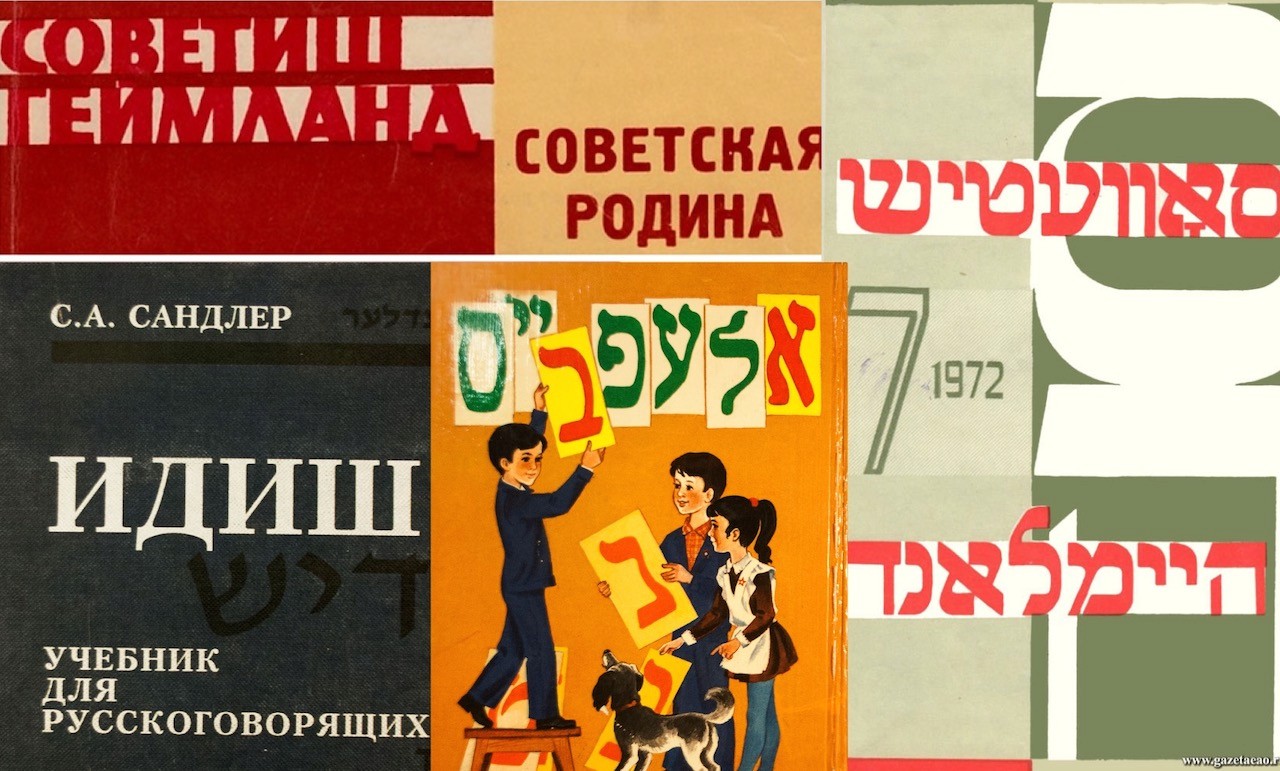
Regarding the authors who continue to write in Yiddish in the 21st century, it should be noted that a significant portion of those holding key positions in contemporary Yiddish literature received professional literary training during the late Soviet period. This occurred primarily within the "Yiddish" group of the Higher Literary Courses at the Maxim Gorky Literature Institute in Moscow, which were organized by Aaron Vergelis, the long-time editor-in-chief of the journal "Sovietish Heymland," and funded by the Soviet state. Among the graduates of the "Yiddish" group (which was recruited twice) were Lev Berinsky, Boris Sandler, Mikhail Krutikov, Moishe Lemster, and the author of this article.
Other Soviet authors writing in Yiddish belonging to the generation born in the late 1940s and 1950s published in "Sovietish Heymland," a prestigious monthly journal of the Union of Soviet Writers that paid royalties (unlike modern Yiddish literary publications). The first books of two of these writers—Lev Berinsky and Boris Sandler—were published by the Moscow publishing house "Sovyetsky Pisatel" at the expense of the Soviet state. This situation, unique to the USSR, was driven by the Soviet regime's willingness in its final decades to invest some funds into maintaining at least a facade of Soviet Jewish culture (with Yiddish no longer taught in schools, little else could be expected) and undoubtedly facilitated their professionalization.
The current demand for Yiddish literature as an element of ethnic identification for certain groups of the Jewish people—by no means limited to Russian-speaking Jews—is driven not by nostalgia for the Soviet past, but by the fact that Yiddish, while being an ethnic Jewish language, is simultaneously a European language, both genetically and in terms of its traditional geographical distribution. Yiddish and the rich secular culture created in it, which is concurrently national-Jewish and European, can serve as a symbol of an alternative type of Jewish identity both in the Diaspora and in the State of Israel, distinct from both the new (at least for Jews retaining Russian as their primary language) Hebrew-Middle Eastern type and the traditional-religious type (which for most modern Russian-speaking Jews is also, if not entirely new, then a deeply forgotten past).
An attempt to find European parallels to this seemingly unique Jewish cultural-identity phenomenon inevitably brings to mind several national literatures currently written in languages that are no longer fully spoken, or even spoken at least, by the majority of their respective ethnic groups. Literatures in some of these languages—such as Irish, Basque, and Belarusian—receive state support. The operation of literatures in others—such as Breton and Occitan—is sustained solely by public organizations. In cases like contemporary Manx and Cornish literatures, we are dealing with relatively small groups of enthusiasts attempting revitalization. Nevertheless, all these literatures are sought after as symbols of their respective ethnic identities.
Unlike the aforementioned minority European languages and their literatures, Yiddish and the literature created in it in the 21st century cannot serve as a symbol of ethnic identity for the majority anywhere. In the State of Israel, where Jews constitute the absolute majority of the population, Hebrew firmly occupies the role of the national language, both in daily linguistic practice and as an ethnic symbol. However, returning to Russian-speaking Jewry, it should be emphasized that the very fact of its formation as a distinct sub-ethnic/ethnolinguistic group is a continuation of a centuries-old tradition of multi-layered Jewish identity and traditional multilingualism.
The identity-linguistic specificity of this recently formed sub-ethnic group of the Jewish people lies in the fact that its "own" languages are Hebrew, Russian, and Yiddish.
The first serves as the common language of the ancient national-religious tradition for all Jews (and, in recent decades, as the language of inter-communal, and for the younger generation, intra-communal communication among members of the largest current ethno-civic group of the transnational Russian-Jewish diaspora living in Israel).
The second serves as the primary spoken and literary language of this community, while the third represents the language of the historically recent past of Russian-speaking Jewry. This historical language unites it into a single historical and cultural whole with other modern sub-ethnic groups of predominantly Ashkenazi origin—primarily English- and Spanish-speaking Jewry, as well as Hebrew-speaking Ashkenazi Jews in Israel. In this context, Yiddish and the culture created in it symbolize not the Russian nor the Israeli, but specifically the Jewish component within the contemporary multi-layered identity of Russian-speaking Jewry.
The views expressed by the experts do not necessarily reflect the official position of the Institute for Euro-Asian Jewish Studies or the Euro-Asian Jewish Congress.
