This is an automated translation and may contain inaccuracies. For citation purposes, please refer to the original Russian version.
The IDF's military operation "Iron Swords," launched in response to the barbaric attack on Israeli cities and towns on October 7, 2023, by militants of the Hamas terrorist group that rules the Gaza Strip, has triggered a massive wave of antisemitism worldwide, including in Western countries. According to monitoring data from the Israeli Ministry of Diaspora Affairs and Combating Antisemitism, the first three weeks of the war alone (October 7–25) saw a 330% increase in antisemitic violence compared to the same period last year, while the total number of antisemitic incidents grew fivefold.
Social media networks, which propagate xenophobic and antisemitic content extensively and with virtually no restrictions, only catalyze this process. While far-left and Islamic antisemitism in Western countries was previously somewhat disguised as "legitimate criticism of Israel," the need to maintain such a guise now appears to have been abandoned by these circles.
In this context, the situation in the former USSR seemed somewhat more favorable. It has been widely assumed that with the collapse of the Soviet Union, the cessation of anti-Jewish policies and discriminatory practices, and the loss of Jews' status as the "main internal enemy" in the public consciousness, the post-Soviet space became a "continent of safety" in terms of overt antisemitic manifestations—at least compared to several European and Middle Eastern nations. For instance, a review by the Jewish Agency for Israel ("Sokhnut") and the WZO, “The State of Anti-Semitism in 2021”, indicated that 9 out of the 20 most high-profile antisemitic incidents occurred in the US, 3 in the UK, 2 in France, and 1 each in Argentina, Italy, Belgium, Sweden, Germany, and Austria. Post-Soviet states did not appear on this list.
Indeed, the annual number of antisemitic attacks and acts of vandalism against Jewish targets in former Soviet republics with significant Jewish populations—principally Russia and Ukraine—ranged from isolated cases to fifteen or twenty incidents during "peak years." Public opinion monitoring in post-Soviet countries consistently showed a steady improvement in the population's attitude toward their Jewish fellow citizens.
General Trends
This generally favorable picture was contradicted by the fact that the assessments of Jews living in these countries were far less unambiguous and diverged significantly from official monitoring data. For instance, over 40% of respondents in a 2018 Levada Center study admitted to having been targets of threats, attacks, or other forms of aggression over the preceding five years. A similar personal experience was reported by more than a quarter of respondents in a survey of Jewish communities in five post-Soviet countries, conducted under the auspices of the Euro-Asian Jewish Congress (EAJC) in 2019–2020, while nearly another third stated that people they knew well had fallen victim to such incidents.
In our view, this dissonance is explained by two factors. First, alongside acts of direct physical violence or harassment (hate crimes), there is a far more pervasive phenomenon of verbal attacks (hate speech), which authorities in post-Soviet countries are highly reluctant to register and include in official statistics. Viewed from this perspective, the positive trend of the first post-Soviet decades reversed sharply starting in the second decade of the 21st century: antisemitism once again became a noticeable factor in the post-Soviet space. In addition to antisemitic rhetoric, there has been a significant rise in incitement, xenophobic provocations, slander against Jews and their culture, Holocaust denial, and antisemitism masquerading as "anti-Zionism."
State-sponsored antisemitism of the Soviet type was not yet in question. However, it should be noted that following the launch of the "Iron Swords" military operation, anti-Israel rhetoric escalated to a new level. A symbolic example is the publication in the high-circulation Russian newspaper Moskovskij Komsomolets on October 21, 2023, of an overtly anti-Israel and antisemitic article subtitled "A Professional Patriot Defines His Homeland." The article was published in connection with a video interview given by Evgeny Satanovsky—a political scientist, orientalist, president of the Institute of the Middle East, member of the Public Council under the Ministry of Defense of the Russian Federation, and former president of the Russian Jewish Congress—which resulted in his subsequent dismissal from a popular Russian television channel. The author of the article, prominent journalist Dmitry Popov, emphasizes "Israel's disproportionate response to the terrorist attack, which results in the deaths of hundreds of innocent civilians and the destruction of residential buildings, hospitals, churches, and mosques. One might even disregard the fact that Israel is a loyal ally of our main geopolitical adversary."
The author concludes his piece with a warning of impending tension between Russia and Israel: "Satanovsky is not the first to define his homeland. And he won't be the last—after all, the conflict has not yet reached its full scale. There will be even more dramatic comings-out." In this brief article published by a popular outlet aimed at a broad audience, the Russian Federation's stance regarding the "disproportionateness of the Israeli response to terror"—already known from official statements by the Russian Ministry of Foreign Affairs—as well as the conflict of interest between Israel and the Russian Federation, is explicitly articulated.
Nevertheless, at present, it is more accurate to say that clear traces of both everyday and Soviet-style state antisemitism remain visible in the former USSR, as do the corresponding fluctuations of antisemitic xenophobia (for example, the proportion of the population harboring such stereotypes in Russia is approximately 40%). This is accompanied by a readiness to support (should the authorities deem it "expedient") policies of ethnic discrimination or restricted access to significant social positions for all "non-indigenous" ethnic groups, including Jews. This is evidenced, for example, by the relative popularity of the slogan "Russia for (ethnic) Russians" and the widespread presence of classified advertisements reading "Apartment for rent/sale to Russians only," which can be seen everywhere on physical and online message boards in both provincial and major Russian cities.
All of this, which was clearly a direct consequence of the surge in antisemitic rhetoric in post-Soviet countries, primarily in Russia, Belarus, and Armenia, came as no surprise to those who had been tracking the rise of antisemitic sentiment over the past decade. The Azerbaijani-Armenian conflict, the war in Ukraine, and the current war in the Middle East have merely accelerated these ongoing processes. Thus, the antisemitic riots in Dagestan demonstrated, as Israeli researcher Dr. Nati Kantorovich correctly argues, that simple and non-binding rhetoric is now a stage of the past, and if deemed necessary, violent antisemitism—much like anti-Zionism—can be brought back to the forefront of the new reality at any moment.
It has become clear that there has been a sharp cooling of Russian-Israeli relations, which, among other things, significantly impacts the status of Jews in Russia. While it is not yet possible to declare a systemic shift and the onset of institutionalized state antisemitism, it is crucial to note the increasing injection of Jewish topics in a negative connotation into the public information space and the gradual normalization of discussing the "Jewish question" in both state media and social networks, originating from the most authoritative state and quasi-state sources in the Russian Federation.
Antisemitic narratives took a sinister turn in the North Caucasus, where on October 28, 2023, a mass rally was held in Cherkessk, the capital of the Karachay-Cherkess Republic, demanding the expulsion of Jews from the region and a ban on Jews entering the republic. Appeals not to rent housing to Jews were widely circulated, and on October 29, an unfinished building of a Jewish religious and cultural community center in Nalchik (Kabardino-Balkar Republic) was set on fire. In the city of Khasavyurt (Dagestan), a message was spread that an individual "resembling a citizen of Israel" was allegedly staying at a local hotel, prompting a crowd to search the premises and inspect vehicles in the area. In Makhachkala, an angry mob effectively seized and ransacked the international airport, where a flight from Tel Aviv landed on the evening of October 29. A lynching of the passengers was prevented solely by the actions of security personnel and police.
Various antisemitic themes, including religiously motivated antisemitic propaganda narratives resembling the "blood libel in Buynaksk," were voiced in social media and public speeches by activists. A petition was sent to the President of Russia calling for the acceptance of refugees from the Gaza Strip and the condemnation of Israel. (The WhatsApp group "Anti-Jews" gathered the full spectrum of such anti-Israel and antisemitic remarks.)
Concerning Yandex co-founder Arkady Volozh, President Putin turned to an unexpected and, in our view, more alarming angle: Volozh was allegedly "forced to make certain statements" in order to live in Israel "at a high standard and maintain good relations with the authorities." The President's statement was perceived as an accusation against the Israeli authorities, who had also faced criticism for insufficient aid to Ukraine and pro-Russian sympathies throughout all stages of the Russia-Ukraine confrontation. It is observable that intense anti-Israel propaganda leads to an explosion of antisemitic sentiments.
The Factor of Cover-up and Incorrect Interpretation
This underscores the importance of the second factor explaining the aforementioned dissonance between the growing apprehension among Jews in several post-Soviet states regarding threats to their personal safety and the official statistics and assurances from authorities. Mindful of their reputation, authorities in post-Soviet countries are highly reluctant to register antisemitic attacks and vandalism, frequently attempting to hush up these events. When such incidents are included in official crime statistics, authorities prefer to classify them as "ordinary hooliganism" or crimes lacking a xenophobic motive. In some cases, local Jewish communities themselves unwittingly contribute to this underreporting. Some observers believe that Jewish communities occasionally prefer not to report antisemitic incidents, particularly violent ones, fearing that doing so might serve as a catalyst for copycat actions.
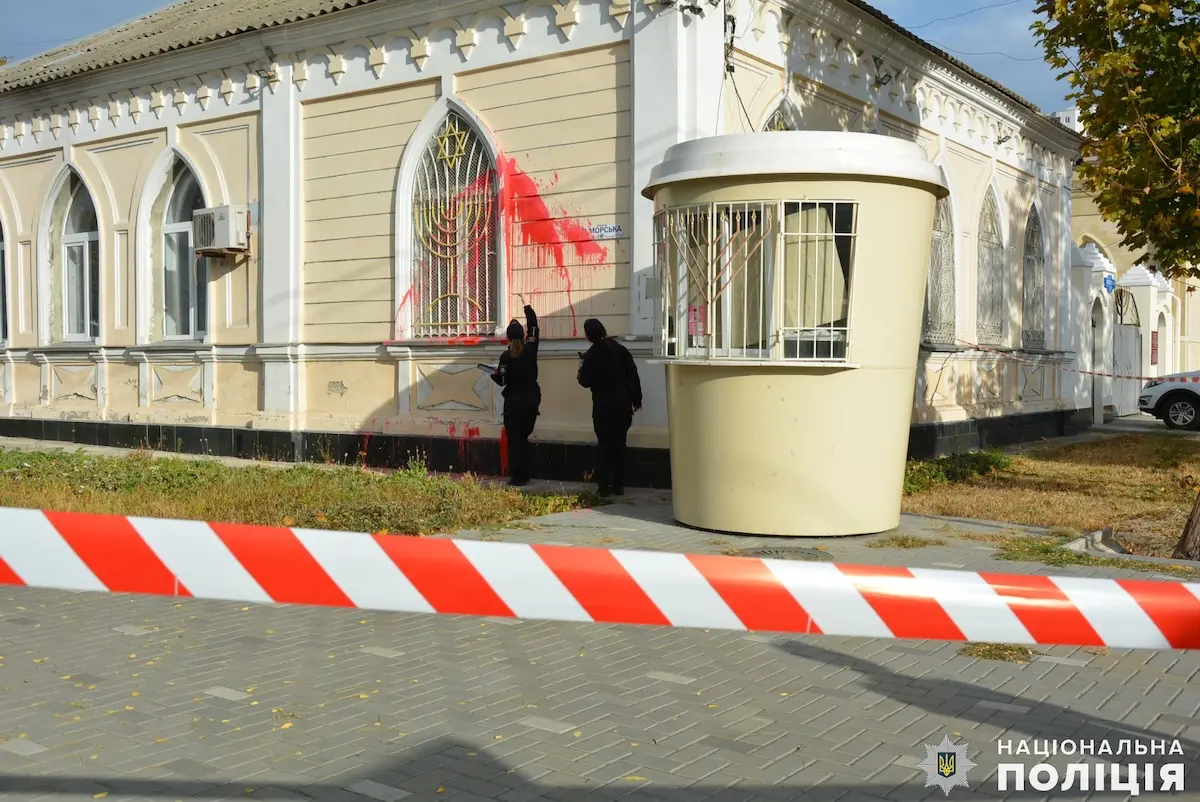
The ongoing war between Israel and the radical Islamist terrorist group Hamas in the Gaza Strip imparts a specific connotation to this relatively new reality. A number of events directly or indirectly related to it in the former USSR have attracted significant attention. One such event was an act of antisemitic vandalism in the Ukrainian city of Mykolaiv, where unidentified vandals defaced the outer wall of the local synagogue—the center of a close-knit, active, and respected Jewish community in a city severely affected by the war with Russia—with red paint symbolizing blood. According to the community's rabbi, Chabad representative Shalom Gotlib, the Ukrainian police took the matter seriously. While the police were investigating "all leads", and local Jews viewed the incident as a direct result of "incitement of antisemitism against the backdrop of the operation in Gaza," a definitive connection between this antisemitic incident and the events in the Middle East has not yet been established. Thus, in this instance, the issue is not so much underreporting as it is that the case remains "under investigation"—there is no indication of an attempt to conceal the incident or its antisemitic nature.
Unfortunately, the same cannot be said for several other occurrences of this nature. Among them are at least two antisemitic acts that have taken place in Uzbekistan since the outbreak of hostilities in Gaza. In Tashkent, two Chabad representatives were assaulted, and anti-Israel graffiti was painted on a synagogue. Neither incident received any coverage in the media, and representatives of the Jewish community also preferred to refrain from comment. In effect, the public only learned of the assault on October 31 from a report by the Israeli Ministry of Diaspora Affairs, prepared jointly with the "Nativ" government bureau under the Prime Minister's Office. The source of the information was a publication by the AZfront Telegram channel, based on reports and photographs submitted by readers.
A similar situation occurred in Armenia, with the distinction that representatives of the local Jewish community have, in several instances, been far more cautious than those in other post-Soviet states about publicizing incidents of an explicitly antisemitic nature. They have cited the provocative character of reports emerging against the background of the Azerbaijani-Armenian conflict. The motives behind this stance presumably include a desire "not to escalate the situation," which proponents of this approach believe could trigger negative consequences primarily for Jews. It also reflects an effort to demonstrate maximum loyalty to the authorities during a time of conflict with neighbors—a consideration that is likely highly relevant given Yerevan's pivot toward a strategic partnership with Western nations.
Over recent months, the country's sole synagogue in Yerevan has been targeted in at least three attacks, including arson attempts, which began prior to the war in Gaza. The first arson attempt in September 2023, whose perpetrators remain unidentified, was kept quiet by the community's leadership, apparently guided by the aforementioned considerations. (Photographs of the aftermath of the attempted arson and discussions of antisemitism in the country were deleted from the local community's Telegram channel). Consequently, this event became known only after two similar acts occurred in October and November 2023, for which responsibility was claimed by the "revived" ASALA group (Armenian Secret Army for the Liberation of Armenia), an organization designated as terrorist by the US Department of State.
In this case, representatives of the local Jewish community acknowledged the presence of anti-Israel sentiments in Armenia, linked to Azerbaijan's allied relations with the Jewish state. However, they simultaneously deny (contrary to reports by Israeli government bodies, investigations by American and Israeli think tanks, and global media coverage) the existence of any antisemitic sentiment in Armenia, attributing the occurring antisemitic incidents to "attempts by Armenia's external enemies to discredit the country."
While the motives compelling the leadership of these and other post-Soviet communities to act in this manner are understandable, it remains true that concealing information about antisemitic incidents distorts the perception of reality. It also hinders the development of adequate policies to suppress and prevent these destructive processes. It is vital to emphasize that transparency and demanding that authorities conduct professional and objective investigations into such incidents are critical factors in combating and preventing such manifestations in the future.
The views expressed by the experts do not necessarily reflect the official position of the Institute for Euro-Asian Jewish Studies or the Euro-Asian Jewish Congress.
