This is an automated translation and may contain inaccuracies. For citation purposes, please refer to the original Russian version.
One hundred years ago, on July 21, 1924, a resolution of the Joint Distribution Committee's Executive Committee established Agro-Joint—a long-term program designed to resettle Jews from unemployment-stricken shtetls into new agricultural colonies in Southern Ukraine and Crimea. On November 25, 1924, Agro-Joint signed an agreement with the Soviet government. As of January 1, 1937, Agro-Joint serviced 133 Jewish collective farms (kolkhozes) in the Ukrainian SSR and 85 enterprises in Crimea, totaling 218 kolkhozes that were home to 13,250 families. The organization's activities in the USSR concluded tragically: the total number of individuals repressed in 1937–1938 due to their real or alleged involvement in Agro-Joint activities was approximately 70 people. During World War II, the Joint provided assistance to Jewish refugees and delivered substantial shipments of food, as well as medical supplies and hospital equipment addressed to the Soviet Red Cross. However, the post-war consolidation of the regime and mounting state-sponsored antisemitism ruled out further contact with the world of American philanthropy.
The Doctors' Plot
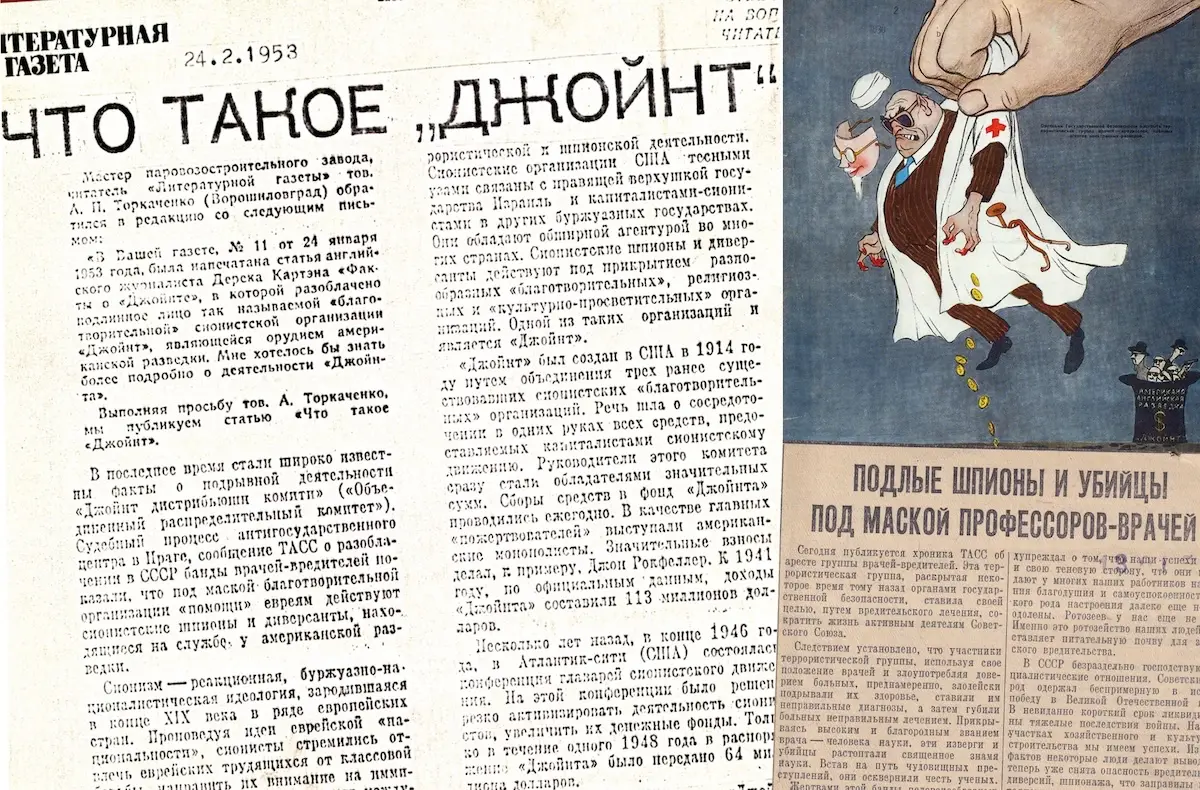
The Joint first became widely known in the USSR in 1953, during the final months of Stalin's life. Authors writing about the Joint in January and February of 1953—during the public explanatory campaign associated with the arrest of the Kremlin clinic physicians, known as the "Doctors' Plot"—operated with a negligible amount of factual material. Notably, according to a TASS report dated January 13, 1953, "the majority of the members of the terrorist group were connected to the international Jewish bourgeois-nationalist organization 'Joint.'" The Soviet propaganda apparatus failed to provide any substantial, real information about the Joint beyond a few clichéd phrases. It took more than a month to prepare the comprehensive article "What is the Joint," published on February 24 in "Literaturnaya Gazeta." The objective of the piece was to expose "the Joint's espionage network and the methods underlying its subversive terrorist activities." The primary source utilized by "Literaturnaya Gazeta" was an adapted entry on the Joint Distribution Committee from the sixth volume of The Universal Jewish Encyclopedia, published in 1942.
From the "Literaturnaya Gazeta" article, readers learned the key assertion: the "Joint" was an instrument of the US Department of State, working in direct contact with American diplomats. Similarly, in V. Minaev's article "Zionist Agents of American Intelligence" ("Novoe Vremya," 1953, No. 4), extensive space was dedicated to the Joint, yet the author failed to convey any coherent details regarding its operations. The entirety of the information he compiled amounted to the following:
«The Joint organization (full name: the Joint Distribution Committee) was established in the United States during the First World War. Its officially proclaimed purpose is to facilitate aid from American Jews to their coreligionists in foreign states. However, in the eyes of the author and the sponsors of this text, philanthropy "served and continues to serve merely as a cover for the espionage and sabotage activities of this organization, which was created by American intelligence."»
The Joint expanded its operations extensively after World War II in the People's Democracies, Minaev continued. According to the author, its "criminal activities" in these nations were directed by a "European division" led by American intelligence agent Schwartz (referring to Joseph Schwartz, a prominent American Jewish leader who served as Director-General of the Joint's European Executive Council from 1942 to 1950). Thus, a spy network of Jewish bourgeois nationalists associated with the Joint was allegedly uncovered in the Hungarian People's Republic. In December 1949, the Joint's director in Hungary, I. Jacobson[1], was expelled from the country for espionage and subversion.
The 1953 press campaign against the Joint subsided in late February. The final mention of the organization in the Soviet press during this period appeared in an article by B. Polevoy, "A Faithful Friend of the Soviet Union" ("Pravda," March 16, 1953), dedicated to the memory of Klement Gottwald, the President of Czechoslovakia and leader of the Czechoslovak Communists, who died on March 14, 1953. Among the agents of "reaction and its imperialist masters," Polevoy made reference to the "bloody gangs of the Joint."
The KGB of the USSR on the "Joint"
The de-Stalinization of society did not imply a revision of history or a shift in the USSR's stance toward Western organizations. The perception of the Joint as an American subversive organization, established during late Stalinism, re-emerged in the 1956 textbook "Anti-Soviet Activity of Jewish Nationalists and the Fight Against Them by State Security Organs," produced for cadets of the KGB Higher School.
The chapter "Jewish Bourgeois-Nationalist Organizations Operating in the USA" permanently solidified the Joint's position on the list of primary "Zionist agencies" of American Jewry. The authors of the textbook outlined the history of Agro-Joint utilizing the clichés of indictment records from the Great Terror (1937–1938):
It was established by American capitalists in 1924 to assist Jewish agricultural colonies in the areas of Kakhovka, Nikopol, Dzhankoy, and Yevpatoriya (Southern Ukraine and Crimea). However, the board of 'Agro-Joint' had little interest in these colonies. Its primary activity was gathering intelligence for American espionage. To this end, 'Agro-Joint' extensively recruited specialists of Jewish nationality who had emigrated to the USSR from Germany after the fascist coup. State security organs exposed a number of 'Agro-Joint' agents and revealed the espionage character of this organization. Consequently, by decision of the Soviet Government, the activities of 'Agro-Joint' were banned in 1937."
Regarding the contemporary operations of the Joint, the textbook stated:
The primary governing body of the 'Joint' is located in the USA, in New York. The European center of the 'Joint,' which operates against the Soviet Union and the People's Democracies, is situated in Paris. In its subversive activities, it extensively utilizes the services of Israeli diplomatic missions in the People's Democracies. The 'Joint' launched active anti-Soviet operations during the Great Patriotic War and in the post-war period. In the interests of American intelligence, branches of the 'Joint' compile detailed information on the Jewish population of the Soviet Union, paying particular attention to individuals with relatives in capitalist countries.
The authors proceeded to describe the "subversive" activities of the Joint in Poland, Hungary, and Romania, alleging that "under the guise of rendering aid to Jews, the Joint engages in gathering intelligence on the Soviet Union and the People's Democracies" and provides financial support to "reactionary organizations in various countries conducting hostile work against the democratic camp." For example, in the People's Democracies, the Joint supposedly "supported and financed reactionary groups opposing socialist transformations." Finally, on espionage, the authors claimed that "acquired economic intelligence" was sent by the Joint to the "Jewish Reconstruction Committee" in New York, headed by Zionist bankers and industrialists, where, "utilizing the Joint's information, they advise the American government on matters concerning US economic relations with other nations."
The Functions of the Joint in Soviet Propaganda
The initial Soviet anti-Zionist publications of the late 1950s and early 1960s were framed as "anti-religious" works, wherein a lack of verifiable facts was compensated for by elaborate fabrications regarding the recent past. The humanitarian aid provided by the Joint to the peoples of the USSR during the famine of the early 1920s and World War II was reclassified as subversion. One of the first to take an interest in the history of the Joint was the "religious scholar" F. Mayatsky. In 1964, his book "Modern Judaism and Zionism" was published in Kishinev. His inventions targeted the massive US aid program during the first Soviet famine (1921–1923), during which kitchens established by the Joint saved at least two million lives. He wrote the following regarding that era:
Hiding behind false rhetoric about the necessity of assisting impoverished Jews in European countries, and with the permission of the US government, Jewish capitalists in the US established the international 'philanthropic' organization Joint in 1914 <…> Following the First World War, the Joint was extensively utilized by the US government to collect intelligence of interest to American espionage. The Soviet people became acquainted with the activities of such organizations during the difficult years for our Motherland, when the population of the Volga region suffered from famine and when the ARA ('American Relief Administration') was established to 'help' the starving. However, the ARA was less interested in organizing relief than in the overthrow of Soviet power. In these activities of Hoover's ARA, a significant role belonged to the 'Joint,' which collected espionage material under the guise of aiding 'impoverished Jews' (F. Mayatsky, Modern Judaism and Zionism. Kishinev, 1964, p. 54).
In addition to such polemical texts, the Joint occasionally appeared in works of fiction. In 1985, A. Polyakov's "chronicle-novel" "Sabotage under the Banner of Aid" was published in Moscow. The author attributed the following remarks concerning the Joint's work in Ukraine in 1921–1922 to Colonel Haynes, "head of ARA operations in Odesa":
The Joint will send nothing to the poor Jews; let them rather die. The Joint is a Zionist organization. The wealthy Jews of America send food to the Zionists—the wealthy Jews of Odesa. But do you think this is free of charge? Not at all! The Zionists trade these goods on the market for valuables and ship them with our transports to America under specific conditions: twenty percent to the captain and twenty to me. Business is business… (p. 170).
Yu. Ivanov, the prominent author of "Caution: Zionism" (Moscow, 1969), put forward the following claims regarding the Joint's activities in the USSR:
In 1927, I.S. Schneersohn departed the Soviet Union for bourgeois Latvia to assume the position of Chief Rabbi of Riga. In Germany, Schneersohn soon met with two representatives of major American capital. Following this meeting, Schneersohn became a central and self-serving figure in transmitting a highly significant sum of money from the American subversive Zionist organization Joint to its agents in the USSR (pp. 77, 221).
Another prominent propagandist, V. Bolshakov ("Zionism in the Service of Anti-Communism," Moscow, 1972), added the following information:
"In 1930, the activities of the so-called 'Leningrad Relief Committee' (LEKOPO) were banned. The investigation revealed that this committee served as a 'front' covering the operations of the subversive Zionist organization Joint on the territory of the USSR" (p. 22).
In the first half of the 1960s, the most prominent anti-Zionist, "religious scholar," and critic of Judaism was T. Kichko, who served as a figurehead for early anti-Zionist campaigns. Kichko's fabrications were extensive. For instance, in his work "Judaism Without Embellishment" (Kyiv, 1963), he asserted that Zionists and representatives of the Joint openly conducted propaganda operations in the post-war Stalinist USSR—including promoting Jewish emigration to Palestine under the rule of "British colonizers"—supposedly aided by "certain ministers of Judaism."
In the manufactured narrative of state propagandists, the non-political Joint was cast as the leader of "international Zionism." Establishing this adversary did not require evidence or reliable sources; assertions such as the following sufficed: "The Joint is engaged not only in raising funds for the treasury of Zionism, but also in direct hostile activity against the USSR and other socialist countries."
The author of this statement, V. Bolshakov, subsequently expanded upon his claims regarding the Joint:
The Joint represents a highly critical link in the system of Zionist organizations, and not merely in terms of its fundraising role. The Joint is not solely a fundraising institution. Above all, it is a primary political strike organization of international Zionism, a major espionage hub active on the anti-Soviet, anti-communist front <…> Practically all Jewish philanthropic and charitable societies, as well as fundraising associations and groups, fell under the control of the Joint. According to American sources, the Joint is supported by all sections of American Jewry—Orthodox, Conservative, and Reform—through the United Jewish Appeal and other organizations. Significantly, the Joint typically allocates less than one-fourth of its total budget to assist Israel. The remainder is directed toward anti-Soviet, anti-communist activities and the subsidizing of Zionist networks (V. Bolshakov, "Zionism in the Service of Anti-Communism," Moscow, 1972).
Other writers, such as V. Zhukov ("The Goals and Methods of Militant Zionism," Moscow, 1971) and B. Prakhye ("In the Trap," Odesa, 1975), described the Joint in a similar manner. "An organization established in 1914 nominally for philanthropic activities among the Jewish populations of other countries," alongside B'nai B'rith, the WZO, the American Jewish Committee, the Women's International Zionist Organization, HIAS, the Jewish Defense League, and others, constitutes "a component of the American Zionist lobby." According to their narrative, the Joint "was frequently utilized by American intelligence for subversive purposes against the young Soviet Republic" and, following World War II, "collaborated with the CIA and Israeli intelligence."
A similar narrative surrounded the package delivery program for needy Soviet Jews, primarily the elderly and religious, initiated by the Joint in the early 1960s. Since the packages arrived through intermediaries, notably the Dinerman company, the actual initiator of the program remained unidentified in most propaganda, referred to simply as "Zionists" or a "Zionist organization." State-directed exposures of the "Zionists" at Dinerman followed a uniform template: an indignant recipient of a package would write a letter of protest to a newspaper, and the editors would explain that "the Zionists seek to acquire political capital through their packages."
In March 1964 alone, major newspapers including "Izvestia," "Pravda Vostoka" (Tashkent), "Sovetskaya Latviya," and "Vechirniy Kyiv" published articles with revealing headlines ("'Kindness' with a Distant Target," "Take Your Gift Back, Gentlemen," etc.) of virtually identical content. Vivid imagery, such as "a fat spider fattened by the efforts of international Zionism and imperialism," was employed by correspondent B. Sidorenko in the article "The Dirty Gold of the 'Joint'" ("Radyanska Ukraina," August 1978).
These exposés regarding the packages relied on local accounts. For example, B. Prakhye, in his book "In the Trap" (Odesa, 1975), wrote of Mnicha Chemerinskaya, a former resident of Belgorod-Dnestrovsky and "a zealous Zionist who emigrated to Israel after the war." The author claimed that "Chemerinskaya actively cooperated with the Zionist organization 'Joint,' which, under the guise of charity, engaged in recruiting individuals to emigrate to Israel." Furthermore, he asserted that "Chemerinskaya received a substantial reward for every person lured to the 'promised land' through deception." In Belgorod-Dnestrovsky, the author concluded, "residents have long since exposed the dirty machinations of Chemerinskaya and Co. Fewer and fewer people are willing to take their bait. Soviet citizens reject packages from Zionist 'benefactors' with anger and indignation."
In March 1975, the Secretariat of the Central Committee of the Communist Party of Ukraine adopted a resolution "On Measures to Strengthen Political Work in Connection with the Inflow of Packages and Ideologically Harmful Correspondence from Capitalist Countries," which noted that "postal channels are being actively exploited by Zionist elements abroad to incite emigration sentiments among individuals of Jewish nationality."
Another prominent theme in Soviet propaganda was the exaggeration of the difficulties of absorption faced by Soviet Jews in Israel. Because the Joint, alongside HIAS, oversaw the emigration of those who chose to settle in the United States and other Western nations, the organization naturally drew the attention of Soviet propagandists.
A brief article in "Pravda" ("The Truth About the 'Promised Land'") on June 3, 1976, reported with clear satisfaction:
A group of individuals with haggard faces and worn clothing stands at the doors of the Zionist organizations Joint and HIAS <…> After spending a year or two in Israel, they fled. An elderly man, who requested anonymity for fear of Zionist retaliation, told a TASS correspondent that living in that country is impossible. It is better to die, he said, than to return to Israel. The Zionists, who speak constantly of Jewish 'brotherhood,' deceived us. In the West, we face indifference from Jewish organizations toward our family. For a year now, he continued, we have lived in Rome; we have no work, our children are starving, and the gentlemen from the Joint and HIAS tell us: 'If you do not want to return to Israel, you can all rot, it does not concern us...'
Like other propaganda materials, these articles aimed to suppress the waves of emigration from the USSR. Even the temporary decline in emigration during the early 1980s did not diminish the ideological pressure.
"Let us mention another 'agency'—the 'Joint,' headquartered in New York. There is no significant difference between the activities of the 'Joint' and HIAS. It is worth noting, however, that the Vienna branch of the 'Joint' constantly collaborates with the so-called 'Jewish Documentation Center' of S. Wiesenthal. And who is Wiesenthal? This question was answered with sufficient accuracy by Austrian Chancellor B. Kreisky, who emphasized that this human rights advocate is a former Nazi agent and a current American spy" (B. Sheinin, "Drugged by Zionist Ravings," Izvestia, June 17, 1981).
In the latter half of the 1980s, the terminology used to describe the Joint was updated, framing the organization as an active participant in "psychological warfare" against the USSR. It was asserted that "The techniques and methods of psychological warfare are developed in various US research institutions, in nominally charitable organizations—such as the 'Joint'—and in travel agencies, among others" (L. Modzhorian, "Terrorism: Truth and Fiction," Moscow, 1986, p. 91).
***
Although the accusations against the Joint were formulated during the late Stalinist period, they were utilized by the regime without substantial modification over the subsequent three decades, up until its collapse. Data regarding the Joint was drawn by Soviet commentators primarily from the published materials of January and February 1953. All subsequent writings represented creative adaptations of these themes; however, because the "Doctors' Plot" remained a taboo subject in the post-Stalin USSR, these historical assertions regarding the organization were published without citing their original source.
Propagandists could publish these claims without concern for verification, as no public debate or fact-checking was permitted. The majority of authors never consulted sources beyond the 1953 newspapers, frequently quoting one another's fabrications. Through the state media, the ideological apparatus succeeded in instilling a basic premise within the collective consciousness: that Israel, Zionists, and Jews represented a hostile influence acting against Soviet society. At the same time, the impact of this campaign should not be overstated: ideological invectives and the names of obscure foreign Jewish organizations held little interest for citizens focused on daily survival within the challenging environment of "developed socialism." This flow of anti-Zionist literature ceased in 1988–1989, as Perestroika entered its final phase and the state leadership began a fundamental revision of state ideology, leading to the end of state funding for such publications.
Since that period, similar themes have been maintained by various nationalistic entities within the Russian Federation. The earlier ideological framework has been discarded; the authors' positions are no longer masked by rhetoric of "internationalism" and are instead presented from a standpoint of Russian nationalism. The established methods of Soviet anti-Zionist propaganda have been adapted by contemporary Russian commentators within the context of modern information conflicts: long-standing themes reappear in public statements, are disseminated by state-aligned media, and find resonance among certain segments of the public. Philanthropic organizations, with their specific focus on assisting elderly Jewish populations, remain a target for contemporary state propaganda narratives.
[1] Gaynor Israel Jacobson (1912–1999) served as director of Joint programs in Italy, Greece, Czechoslovakia, and Hungary from 1944 to 1949, and as Director of HIAS from 1966 to 1981.
The views expressed by the experts do not necessarily reflect the official position of the Institute for Euro-Asian Jewish Studies or the Euro-Asian Jewish Congress.
