This is an automated translation and may contain inaccuracies. For citation purposes, please refer to the original Russian version.
The evolution of antisemitism in Russia, as in most of the world, is clearly shaped by both long-term structural processes spanning extensive periods of human history and immediate factors arising from rapidly changing, transient circumstances.
In fact, we are looking at two mutually influential (and sometimes conflicting) phenomena: first, what can be termed "popular" or "everyday" antisemitism, and second, "elite" or "ideological" antisemitism. To examine the latter in the Russian Federation, including the ideological discourse of two major currents within politicized Russian nationalism—imperial and "ethnic"—this study utilizes a content analysis of Telegram channels conducted by researchers at the Moscow Center for Ethnopolitical and Regional Studies (CESR). This study has allowed us to pinpoint the rise and fall of the wave of popular antisemitism, confirming sociologists' findings regarding the awakening of "dormant antisemitism" triggered by the agitation of Russian society following the events of October 7 last year. Specifically, this refers to the terrorist attack by the Hamas group and the subsequent Israeli military operation in the Gaza Strip. These events were perceived in Russia, and to some extent globally, as a new escalation of the Palestinian-Israeli conflict.
Telegram Channels as a Subject of Research
Between October and December 2023, key Russian media outlets adopted a fairly overt pro-Palestinian stance, focusing audience attention on civilian casualties in Gaza, which immediately influenced Russian public opinion. Research by the Levada Center (recognized by Russian authorities as a "foreign agent" NGO) showed that no more than 6% of Russian respondents expressed sympathy for Israelis in the current conflict, compared to about 20% for Palestinians, rising to nearly half—46%—among Russian Muslims. Meanwhile, official media outlets operating under quite strict informational guidelines cannot be accused of spreading overtly antisemitic content. The primary source of such content in the Russian media landscape is social networks, and above all, Telegram channels.
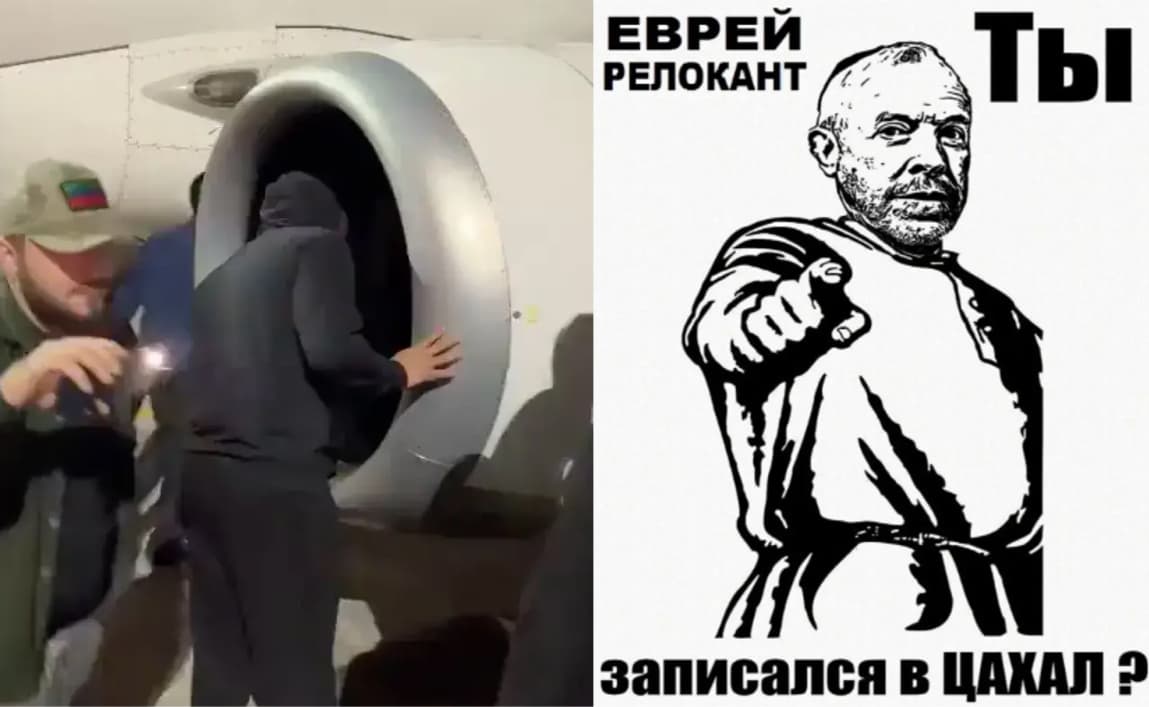
Regarding the October events in Makhachkala, the theory of direct incitement of rioters via Telegram channels was voiced at the official level. For instance, at a briefing on October 30, 2023, the Head of the Republic of Dagestan, S. Melikov, stated that the crowd's actions were provoked by publications in the "Utro Dagestana" (Dagestan Morning) Telegram channel.
Currently, Telegram is the most popular platform for socio-political blogging that remains unrestricted by the Russian authorities. Combined with the lack of censorship by the platform's administration, this has led to an extremely rapid growth in the importance of Telegram channels as a source of current socio-political information with interactive commenting options. The audience of the most popular Russian-language Telegram channels already numbers several million readers ("Pryamoy Efir", "RIA News", Readovka, Mash, etc.). More specialized channels in the socio-political segment have fewer subscribers, but their audiences still frequently range in the tens and hundreds of thousands of readers.
With the above considerations in mind, we conducted a study of the content of selected Telegram channels, consisting of two main analytical approaches:
A quantitative analysis of mentions with varying connotations of specific key marker words related to attitudes toward Jews, Zionism, and the State of Israel in Telegram channels representing different ideological discourses: Russian nationalists, Islamists, and leftists;
An analysis and comparison of the main narratives used by the authors of the selected media resources to describe their attitudes toward Jews, Israel, and Zionism.
Below we present some findings from the portion of this study focusing on channels of authors who can be broadly categorized as "Russian nationalists," including "imperial nationalists." In our view, it is the narratives of this group that most clearly reflect the specifics of Russian "ideological" antisemitism for two main reasons: first, other manifestations of antisemitism are less endemic (for example, the discourse of Russian-language Islamists largely aligns with the global Islamic antisemitic and anti-Zionist discourse); second, for the reason mentioned above—the new Russian elite antisemitism is significantly, if not decisively, linked to the "normalization" and rising popularity of neo-imperial discourse in the modern media space.
A combined four-stage methodology was used to select the Telegram channels: the first stage was the targeted selection of three ideological discourses: Russian nationalists, Islamists, and leftists, within each of which different currents were subsequently analyzed; the second stage involved surveying experts who identify with the respective ideologies regarding their choice of media resources influential in their circles; the third stage was selecting the five channels with the highest number of subscribers in each ideological niche; the fourth stage excluded channels from the study in which mentions of Israel and Jews were virtually non-existent. For instance, the channel of I. Strelkov, popular among Russian nationalists with nearly 750,000 subscribers by early 2023, barely touched upon these topics.
Within Russian nationalism, our study identified two ideological subgroups, which we have termed "imperialists" and "nationalists." We emphasize the provisional nature of these terms, as we have noted in previous publications that virtually the entire core of Russian nationalism is historically imperial.[1]
Today, Russian nationalism continues to intertwine its original imperial interests with newer ethnic ones. These elements manifest in different proportions within the two ideological currents we identified. In the group we termed "imperialists," the dominant ideology is the confrontation between Russia and the West, while in the group called "nationalists," the primary focus is on inter-ethnic relations within Russia. Both groups support Russia's policy toward Ukraine and show other similarities. Nonetheless, differences are apparent in the analyzed content, manifesting as a clear dominance of the words "Ukraine," "Ukrainian," and "SVO" (Special Military Operation) in the discourse of the "imperialists," and the words "migrants," "Muslims," and "Islamists" among the "nationalists."
Content analysis revealed that the topic of Israel, Jews, and Zionism, which was virtually unmentioned prior to October 7, 2023, experienced a sharp spike in mentions on that day, before gradually losing ground over the next two months. However, in October, at the peak of interest, the Jewish topic either approached the central theme of the channel (for "nationalists") or even overtook it (for "imperialists"). In both cases, the topic of Israel/Jews pushed the SVO into the background. The graphs below demonstrate this using the examples of the Colonelcassad Telegram channel, representing the "imperialist" subgroup, and "Russkiy Natsionalist" (Russian Nationalist) from the "nationalist" subgroup.
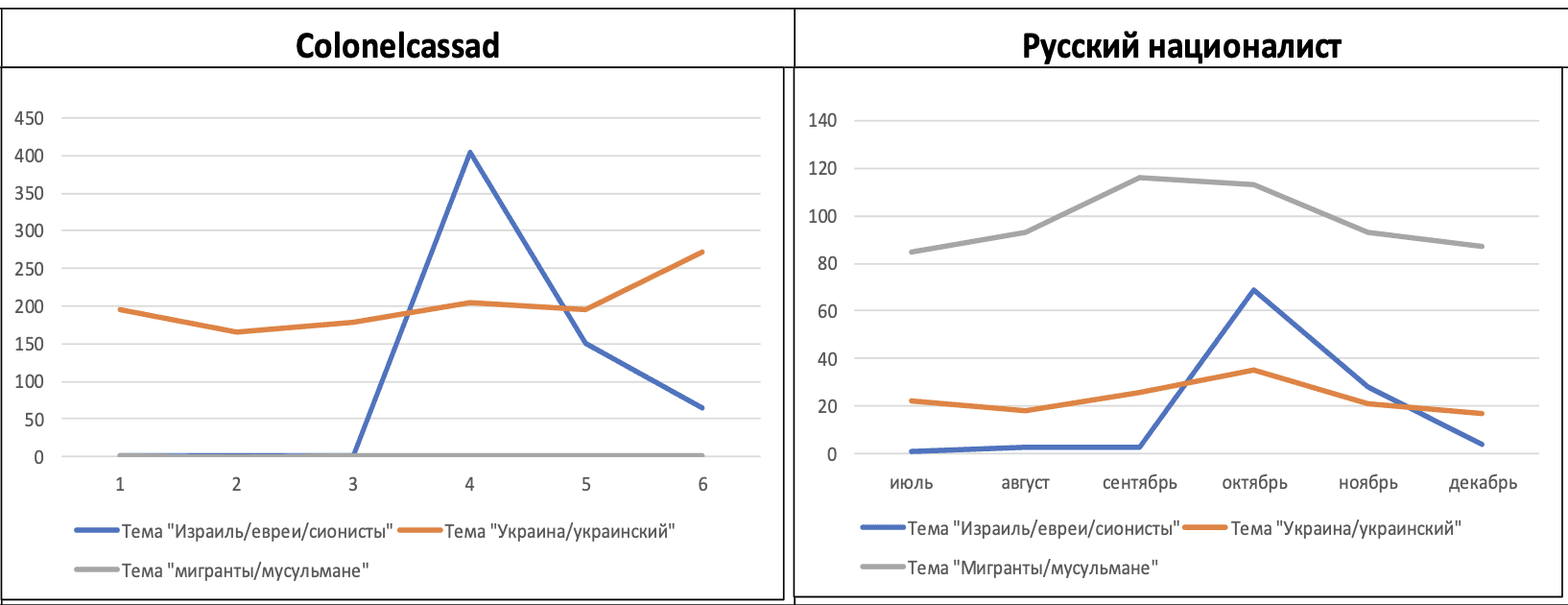
Connotation analysis of mentions of key words ("Israel," "Jews," "Zionists") points to an explosive growth in negative evaluations in October and November, with their share in the total number of mentions reaching a peak of 47% among "imperialists" and 30% among "nationalists." However, the anti-Israel and antisemitic discourse still retains unique characteristics within each of these right-wing factions.
Nationalist-Imperialists
The narratives of the "imperialists" are tightly integrated into the context of the global confrontation between Russia and the West. In this alignment, Israel is viewed as part of the collective West, while Israel's adversaries are seen as part of the "axis of resistance" (a term from Iranian political lexicon frequently used by the channel's authors).
To describe the events in Israel starting from October 7, "imperialists" effectively adopt not only the perspective but also the vocabulary of Islamist, pro-Hamas media resources. For example, one post quotes an advisor to Turkish President R. Erdogan: "We view the 'Al-Aqsa Flood' operation as a legitimate right of defense and fully support our Palestinian brothers," while on October 7, the channel author writes directly: "the Jews were warned that there would be a response, and here is that response."
Throughout the observation period, "imperialists" actively quoted anti-Israel speeches by R. Erdogan, H. Nasrallah, A. Khamenei, Hamas leaders, Yemeni Houthis, and Afghan Taliban. Naturally, posts of this type frequently feature highly negative marker words such as "genocide," "aggression," "occupation," "fascism," "Nazism," "atrocities," and "war crimes" (in relation to Israel's actions in the Gaza Strip), while Hamas militants are periodically referred to as "resistance fighters."
A prominent feature of this discourse is the US and "collective West" support for Israel, contrasted with the condemnation of Russia's actions in Ukraine. This theme is regularly played out in numerous memes and caricatures.
Another area where "imperialists" quite openly cross the fine line between anti-Israel discourse and overt antisemitism is the topic of the Holocaust. Posts like the following are not uncommon: "the pathetic attempts of the perpetrators of mass civilian murders to hide behind the fig leaf of the Holocaust fool very few now" or "certain statements and actions of the Jews evoke the rhetoric of those who once perpetrated the Holocaust."
The attitude toward Jews among "imperialists" is often determined by the stance that individual Jews take toward the conflict. Almost any use of the word "Jew"/"Jews" in a positive connotation refers to anti-Israel protests by certain American Jews. Thus, among the "good" figures, according to the channel authors, is an anti-Zionist rabbi from the US ("we are on the side of the Palestinian Government"), whereas "bad Jews" are represented by examples such as: "radical Jews supporting the mass killings in Israel attacked and insulted a crowd demonstrating in support of Palestine in Rockville, Maryland."
Nevertheless, despite the obvious borrowing of Islamist perspectives and vocabulary, the position of the "imperialists" still differs significantly from it. Indeed, "imperialists" repeatedly emphasize that this is "not their war" and that both sides are alien to them. The Colonelcassad channel quotes Russian political analyst N. Sevostyanov: "The enemies of the Russian World, represented by the leadership of Ukraine, the United States, and Great Britain, wish for Israel's victory with all their might. And the exact same enemies of the Russian World, represented by Russophobes with Wahhabi beards and knife-wielding migrants with brains washed by Russophobia, wish for Hamas's victory with all their might. So let me ask again—are you sure you absolutely must choose a side in this foreign war?"
On this point, the position of the imperialists aligns almost completely with that of the "nationalists," demonstrating two persistent negative stereotypes shared by both subgroups:
A negative attitude toward Israel as a haven for ideologically hostile ("pro-Western") relocants—liberal politicians, musicians, and businessmen (Chubais, Makarevich, Nevzlin, etc.);
An Islamophobia traditional for right-wing movements worldwide, which portrays the Islamic world as the primary threat to the "white," "Christian" world, coupled with an equally traditional hatred of migrants.
Yet, despite the clear similarities between the two right-wing currents, ideological and discursive differences remain noticeable. The antisemitic demonstrations in the North Caucasus in October 2023 were viewed explicitly negatively by both "imperialists" and "nationalists." However, the former saw the hand of "the West and Ukraine" in the events, while the latter blamed the machinations of Islamists, who they believe are shielded by local authorities—something they find particularly dangerous for Russians, who "could become the next victims of pogroms."
Ethnic Nationalists (Anti-Islamists / Migrantophobes)
The riot in Makhachkala is described by the authors of the "Russkiy Natsionalist" channel as an "antisemitic coven," and the Islamist rioters are labeled as Nazis. A characteristic quote states: "First-person footage from the antisemitic coven in Dagestan. As can be gathered from the commentator's words, orders were given not to disperse the Nazis. One can assume that refugees from Israel were doomed to death had they actually arrived in Dagestan on that flight! And do you know the reason for this coven? It is the exact same Islamization," followed by "Russians are next."
When describing events in Israel, nationalists, unlike "imperialists," are often inclined to view the situation through Israeli eyes. For example, the channel's feed features a video showing a Palestinian terrorist in a hijab attacking a civilian Israeli with a knife, accompanied by a comment from a Russian nationalist: "And this is why Palestinian teenagers and women, who are being released under the current deal, were sitting in Israeli prisons."
In another post, responding to a message from a Russian wrestler (a native of the Caucasus) who expressed bewilderment at the lack of Palestinian themes and sympathy for Palestinian suffering in "Slavic" public groups, the channel's author writes: "Well, then go ahead and pity the Jews of Israel who were killed by Hamas, pity the children killed by Islamic terrorists worldwide," and further: "His brothers from the Caucasus said nothing about the SVO and Donbas as a whole for over 8 years. And now this scarecrow thinks that Russians, of all people, should be worrying about some Palestinians. Why on earth should we? Who are they to us?" The post also includes an interesting quote from Alexander Khodakovsky, a prominent military figure from Donetsk: "I am filled with bitterness by what is happening in Israel to cries of 'Allahu Akbar.' It immediately brings back associations with pages of our history when radical Islam unleashed its deadly sting. Now, let us return to the topic of migrants. Watch and take note: this could easily await us as well. They want to achieve our quality of life, but they do not want to accept our customs and norms of behavior for it. They do not aim to assimilate, they do not want to work and earn normally, they want to take everything from us by force."
However, these expressions of sympathy should not mislead: the "nationalists," for the most part, just like the "imperialists," view both sides of the Palestinian-Israeli conflict as alien and hostile. "Israel is demolishing residential buildings in the Gaza Strip. Hamas is keeping children in cages. Does anyone still want to look for who is right and who is wrong among them? To justify anyone? The more intense the conflict is there, the fewer weapons Ukrainians will receive, the faster we will win, and the fewer of our people, Slavs as a whole, will die. That is the only thing that should concern us in this story."
It should be noted that a small offshoot emerged within the "nationalists" subgroup (the "NATSDEM" channel). This current advocates for the creation of a "Russian national state" instead of a multi-ethnic empire, and in the context of the Palestinian-Israeli conflict, it takes a deliberate pro-Israel stance. However, the popularity of this channel, and of the national-democratic current in Russian nationalism as a whole, is minimal. Compare NATSDEM's 17.5 thousand subscribers with "Russkiy Natsionalist's" 28 thousand, let alone the 807 thousand subscribers of the imperialist Colonelcassad.
The most mainstream currents of Russian nationalism exhibit a clear anti-Israel and antisemitic stance. Furthermore, "nationalists," no less than "imperialists," express hatred toward Jewish repatriates who voice support for Israel in its war against Hamas. Russian nationalists show particular hostility toward those liberal Jews and relocants who previously acted as pacifists in Russia, condemning Russian actions in the SVO and fighting against nationalism.
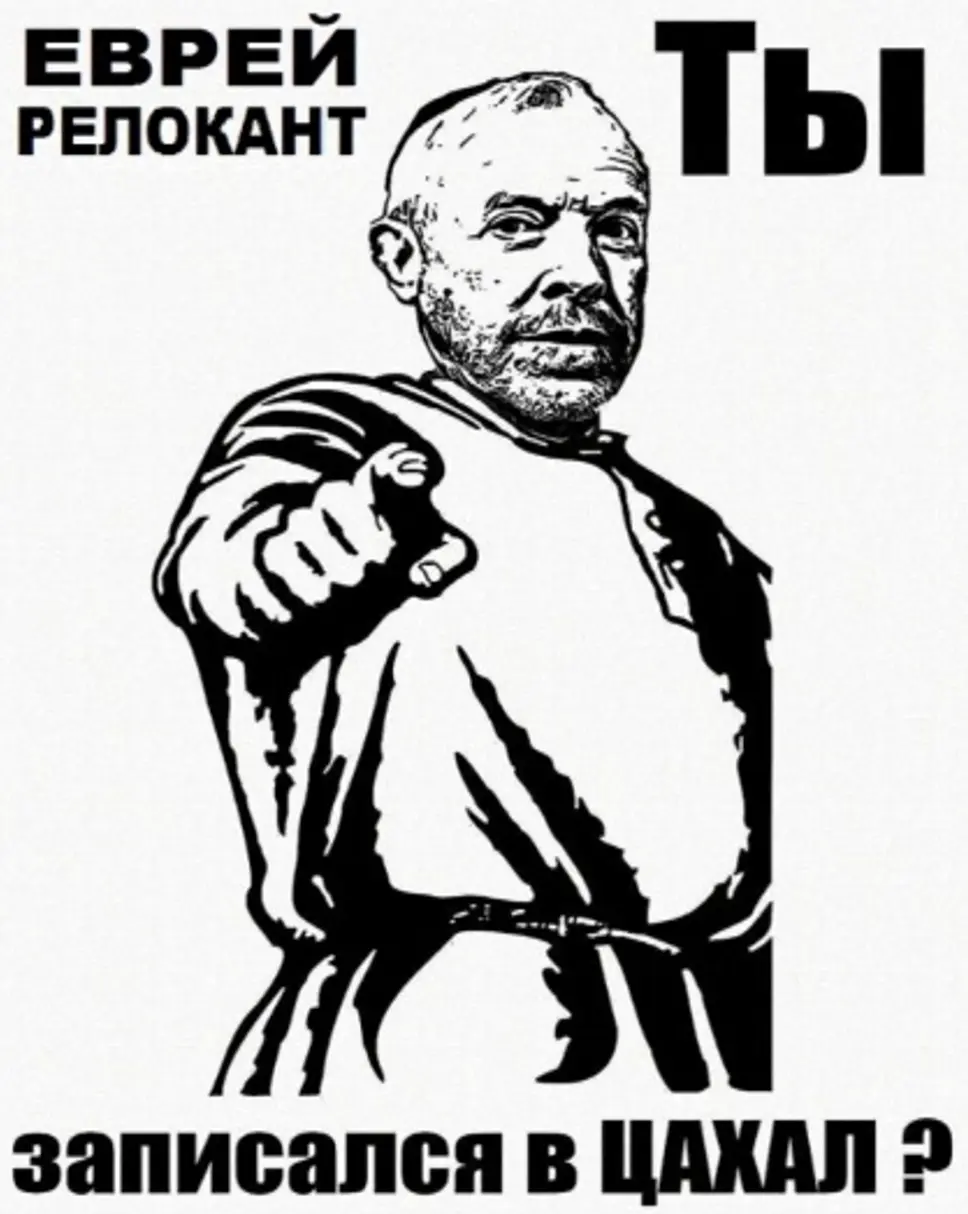
For instance, the author of the "Russkie Natsionalisty" channel, criticizing the position of historian Tamara Eidelman, writes: "...there are hypocrites who claim they are not nationalists and despise nationalism... But this is a lie. Because such people are the truest nationalists, deeply ingrained, convinced, and malicious; they simply speak of a nation or country for which they have no positive feelings. But as soon as you touch their true love... the faces of these non-nationalists snarl, showing bloody fangs. Even Honored Teacher of Russia Tamara Natanovna Eidelman, a kind grandmother, falls to the floor, kicks, foams at the mouth, howling and shrieking, 'Go on, IDF, hit those bastards!'"
Conclusions
The methodology we selected for analyzing the dynamics of antisemitism has led us to the following conclusions.
Throughout the post-Soviet decades, a decline in popular antisemitism was recorded in the Russian Federation, resulting from several factors. First, there was a radical reduction in the size of the Jewish population in Russia, primarily due to their ongoing emigration to Israel, America, and Western European countries. Second, fundamental transformations in the value system of Russian society in the post-Soviet period led to changes in how certain stereotypical "Jewish traits" are evaluated, even while those stereotypes themselves persist. Additionally, shifts occurred at the level of state ideology, resulting in the virtually complete elimination of any elements of Soviet state antisemitism.
These macro-sociological factors did not eliminate popular antisemitism entirely; they merely de-activated it, putting it to sleep. This "dormant antisemitism" is capable of awakening under the influence of various political and media triggers. Unlike popular antisemitism, the influence of these macro-sociological factors on the rises and falls of ideological antisemitism was minor. Much greater was the influence of shorter-term factors, which can be termed "short historical waves," namely: the alternation of periods of reform and counter-reform; shifts in geopolitical vectors; wave-like surges of xenophobia; changes in the hierarchy of the "enemy" image; periodic ethnopolitical conflicts, etc.
The carriers of ideological antisemitism in modern Russia include various political forces (leftists, right-wingers, Islamists, etc.), but the most characteristic, influential, and long-standing tradition belongs to Russian nationalism. This political ideology is internally diverse; therefore, analyzing its discourse allowed us to identify two subgroups of ideological Russian nationalists, differing significantly in the narratives they employ—one we provisionally termed "imperialists," and the other "ethnic nationalists."
In both groups, the Jewish topic is not strategically central; however, due to the events of October 2023, it temporarily moved to a leading position in terms of mentions. For "imperialists," the main source of negative attitudes toward Jews is their specific ideological worldview, centered on the global geopolitical confrontation between Russia and the West, which includes Israel. The emotional intensity of anti-Israel narratives became so strong at one point that negative assessments of the Jewish state's actions were transferred to ethnic Jews. At this juncture, anti-Zionist vocabulary organically transitioned into antisemitic discourse, featuring easily recognizable elements of Holocaust denial (or rather, its specific interpretation as an exclusively propagandistic construct—the "fig leaf of the Holocaust").
In the narratives of both groups, the image of the pro-Western liberal Jew who "fled" Russia to escape the SVO, only to jump "out of the frying pan into the fire" during the latest phase of the Palestinian-Israeli conflict, is clearly present. Among "nationalists," this image is presented in an ethno-cultural framework as a "treasonous" choice of identity. For them, a "bad Jew" is one who chooses their ethnic identity and demonstrates solidarity with the Jewish state rather than the Russian one. Israel is thus viewed primarily as a refuge for former officials and oligarchs who "robbed Russia."
There is a clear pattern in the dynamics of antisemitic prejudice depending on the manifestation of two phobias common to all currents of Russian nationalism—anti-Western and anti-immigrant/anti-Islamic sentiment.
While anti-immigrant/anti-Islamic content does not eliminate anti-Israel and antisemitic sentiments, it often significantly tempers them. The more a channel's content is focused on Russia's confrontation with the West, the more aggressively anti-Israel and antisemitic its response is to news related to the current escalation of the Palestinian-Israeli conflict.
[1] Emil Pain, “The imperial syndrome and its influence on Russian nationalism”. In: The New Russian Nationalism: Imperialism, ethnicity and authoritarianism, 2000-15, Ed. by Pål Kolstø and Helge Blakkisrud. Edinburgh: Edinburgh University Press, 2016, pp. 46-74.
The views expressed by the experts do not necessarily reflect the official position of the Institute for Euro-Asian Jewish Studies or the Euro-Asian Jewish Congress.
