This is an automated translation and may contain inaccuracies. For citation purposes, please refer to the original Russian version.
Today, the native, and often only, language of the absolute majority of American Jews—mostly descendants of Yiddish-speaking immigrants from Eastern Europe—is English. Active Yiddish speakers are estimated to number only about 150,000, the vast majority being members of ultra-Orthodox religious communities. However, among secular and moderately religious American Jews, there is a movement of diaspora Jewish identity proponents dedicated to preserving the Yiddish language and developing its culture. Yet, the attitude towards the Jewish state and Zionism among American Yiddishists is far from simple.
While many of them identify with the State of Israel, there are also quite a few who support American "progressives" and Israeli radical left-wing movements, viewing Zionism as a manifestation of colonialism. This long-standing debate intensified sharply following the October 7, 2023, Hamas terrorist attack on Israeli communities and the subsequent war.
The vast majority of modern American Jews are descendants of immigrants who arrived from Eastern Europe during the late 19th and early 20th centuries and spoke Yiddish. Today, English is the native, and often only, language of the absolute majority of American Jews, whose population is estimated to be between just under 6 million and 7.5 million[1], depending on the criteria used. Active Yiddish speakers are estimated at only about 150,000. The vast majority of them belong to ultra-Orthodox religious communities, primarily the Satmar Hasidim, who preserve the natural transmission of the language to younger generations.
However, among secular and moderately religious American Jews, there is a Yiddishist movement dedicated to preserving the Yiddish language and developing its culture. Its key organizational body is the League for Yiddish, founded in 1979 on the basis of the Freeland Territorialist League of America for Jewish Colonization, which was established in 1942. The printed organ of the League for Yiddish is the magazine "Afn Shvel," published twice a year entirely in Yiddish.
American Yiddishists make notable efforts, on one hand, to popularize secular Jewish culture through translations from Yiddish into English and, on the other hand, to revitalize Yiddish in non-ultra-Orthodox circles by establishing various courses and publishing educational materials for Yiddish learners.
Yiddishism in its modern form is a striking manifestation of secular diaspora Jewish identity, drawing on the rich culture created in the Yiddish language by previous generations of Ashkenazi Jews, and is not directly linked to the State of Israel and its Hebrew-based culture. Proponents of Yiddishism cannot be labeled assimilationists, even if they themselves do not fully speak Yiddish. However, the attitude toward the Jewish state and Zionism among American Yiddishists is far from unanimous. Many—though by no means all—support American "progressives" as well as Israeli radical left-wing movements, viewing Zionism as a manifestation of colonialism.
Predictably, the October 7, 2023, Hamas terrorist attack on Israeli communities adjacent to the Gaza Strip and the subsequent war triggered an intense debate among American Yiddishists over their stance toward Israel and the conflict. In December 2023, the quarterly literary journal "Yiddishland," published in Yiddish in Sweden and Israel, featured a collective letter titled "Yiddishists for Israel," initiated by Noech Barrera, a young American Yiddishist. It stated, in part: "We, Yiddishists, stand united with our brothers and sisters in the State of Israel at this hour of tragedy. We categorically support Israel's right to exist and to defend its citizens and territories"[2]. It was signed by over 100 Yiddishists, mostly Americans (a significant portion of whom are emigrants from the former USSR). The very emergence of such an initiative indicates that support for Israel among American Yiddishists is not taken for granted, even after October 7, 2023.
Heated debates between pro-Israel and pro-Palestinian American members of the movement persisted throughout the past year. Rukhl Schaechter, editor of the bilingual (English and Yiddish) Yiddishist weekly "Forward," attempted to document this in detail in her article "A painful split in the Yiddishist community since Oct. 7"[3]. The article lists several instances of anti-Israel actions by pro-Palestinian Yiddishist activists. In particular, they launched a vocal campaign against the YIVO Institute for Jewish Research in New York—a cornerstone of academic Yiddish studies—accusing its leadership of becoming a "mouthpiece for Israeli propaganda." The attacks were triggered by YIVO's January screening of its three-part documentary on the origins and ideology of Hamas.
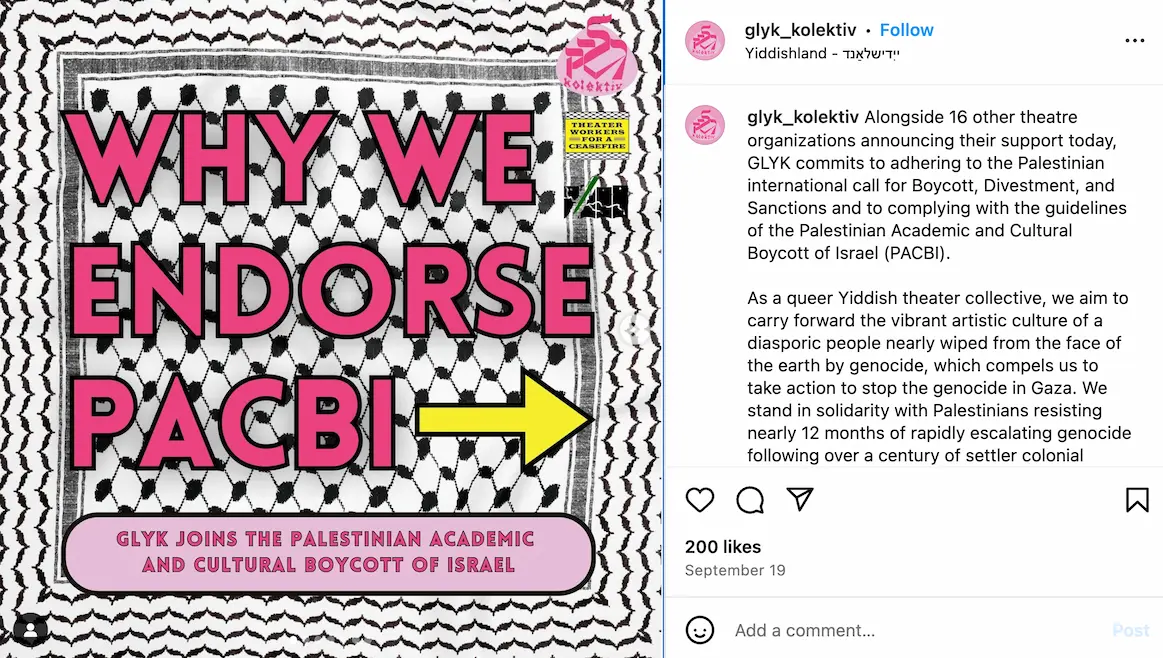
Another public action of this kind was a collective letter published in mid-September on Instagram by actors from the Brooklyn-based Yiddish-language theater troupe "GLYK," announcing their participation in the academic and cultural boycott of Israel. They justified their decision by expressing solidarity with Palestinians who "have been resisting a rapidly escalating genocide for nearly 12 months, following more than a century of settler-colonial violence and ethnic cleansing."
Rukhl Schaechter notes that this collective letter did not come as a surprise, as "the divergence in perspectives between pro-Israel and anti-Zionist Yiddishists has been simmering beneath the surface for years. Since October 7, both sides seem to have been emboldened in publicly expressing their views." Consequently, "following the devastating Hamas attacks on Israel and the onset of the war, a sharp ideological rift has emerged in the Yiddishist world between those deeply connected to Israel and those openly expressing more sympathy for the Palestinian struggle than for the Jewish state."
Notably, pro-Israel American Yiddishists appear to be more on the defensive than the offensive. According to the article's author, after the "GLYK" troupe's collective letter appeared, "some members of the Yiddishist community privately told me they were dismayed by what they saw but chose not to speak out, fearing backlash from other members of the community." Regarding YIVO, its Executive Director, Jonathan Brent, denied during the controversy that the aforementioned "series was pro-Zionist or even pro-Israel, although it was a sober presentation on the collaboration between Nazis and Islamists in the 1940s."
Pro-Israel American Yiddishists adopted a similar stance in the debate over mentioning the events of October 7, 2023, during the annual commemoration of the Warsaw Ghetto Uprising. Since 1949, the Congress for Jewish Culture, along with the Bund and other Yiddishist organizations, has regularly held this ceremony on April 19 at the "Der Shteyn" ("The Stone") memorial in New York's Riverside Park. Shane Baker, Director of the Congress for Jewish Culture, told Rukhl Schaechter that "during a planning session in April, a committee member suggested opening the program with a statement about the 'October 7 pogrom,' calling it 'the greatest massacre of Jews since the Holocaust.'"
However, "while most committee members agreed that it would be appropriate, some felt uneasy because they wanted everyone in attendance to feel comfortable at the ceremony. 'We felt this might be inflammatory to the more left-wing segment of our audience, who also tend to be younger and are likely the future organizers of the event,' Baker said." Some moderate pro-Palestinian Yiddishists suggested commemorating both the Israeli and Palestinian victims of October 7 and the subsequent war, but ultimately, it was decided not to mention October 7 at all.
Some pro-Palestinian American Yiddishists claim to be the ideological successors of the Marxist and Yiddishist Bund party, which historically opposed Zionism and advocated for cultural-national autonomy for Jews in their countries of residence. Their ideology was termed "Doykayt" (hereness)—from "do," the Yiddish word for "here." However, after the Holocaust and the creation of the State of Israel, the Bund revised its stance on Zionism. In 1955, its leadership adopted an official resolution stating that "Israel is a significant factor in Jewish life." Regardless, the Bund has ceased to be a significant political entity, and attempts by modern "progressive" American Yiddishists to position themselves as ideological heirs to the proletarian Bund appear highly artificial. Many elderly American Yiddishists raised in Bundist families now view "progressive" young Yiddishists with alarm and bewilderment, echoing Shane Baker's sentiment: "I simply do not understand how a Jew can say 'From the river to the sea, Palestine will be free.' Many Jews live in Israel. Where are they supposed to go without Israel?"
The most culturally prominent figure among pro-Palestinian American Yiddishists is Zackary Sholem Berger (born 1973), a Baltimore-based bilingual (English and Yiddish) poet, essayist, and translator of Jewish literature into English. Berger belongs to a conservative religious community, studies Hebrew, and actively supports radical left-wing organizations in Israel. On April 28, 2024, he published a post outlining his views on Zionism, the role of the State of Israel in modern Jewish history, and the Arab-Israeli conflict.
In his view, "Eretz Yisrael is one of the important (but not the only important) sites for Jewish autonomy. However, today, Zionism means supporting the State of Israel as it has been built: a nation-state based on Jewish supremacy, ruling over millions of Palestinians who have no representation and no alternative to this occupation." On this basis, Berger concludes: "I do not support nation-states in general, and I cannot support Israel in its current form."
Addressing allegations that the current pro-Palestinian movement in the US is inherently antisemitic, Berger asserts that "supporting Palestinian self-determination is not antisemitic." He supports the right of Palestinian refugees to return and to receive reparations from Israel, yet avoids the question of what would become of Israeli Jews in that scenario. Perhaps the only sign of "moderation" in Berger's pro-Palestinian ideology is his explicit characterization of Hamas as a "reactionary terrorist organization that committed crimes against humanity during its October 7 attack." However, he immediately adds that "this does not absolve Israel of responsibility."
In conclusion, it is worth noting that both Rukhl Schaechter's article and Zackary Sholem Berger's post were published in English, not Yiddish, and became subjects of discussion in that language. Consequently, the debate surrounding the State of Israel within this small but active Yiddishist community is becoming an influential factor among the much broader demographic of liberal American Jews who do not speak Yiddish.
[1] “Jewish Americans in 2020”. Pew Research Center, May 11, 2021, pp. 50-52, https://www.pewresearch.org/religion/2021/05/11/the-size-of-the-u-s-jewish-population/
[2] Yiddishland, No. 21, Winter 2023–2024, p. 3.
[3] Rukhl Schaechter, “A painful split in the Yiddishist community since Oct. 7”, 26.9.24: https://forward.com/forverts-in-english/656976/
The views expressed by the experts do not necessarily reflect the official position of the Institute for Euro-Asian Jewish Studies or the Euro-Asian Jewish Congress.
