This is an automated translation and may contain inaccuracies. For citation purposes, please refer to the original Russian version.
In his study, published on the platform of IMPACT-se—an international organization dedicated to monitoring peace and cultural tolerance in school education—the author analyzes how themes related to Jews, Judaism, the Holocaust, Israel, and the Arab-Israeli conflict are presented in the textbooks of Uzbekistan and Kazakhstan. These topics are present in educational materials and are frequently framed within the context of interfaith tolerance and secularism. Textbooks in Uzbekistan offer more detailed and positive coverage of Judaism and Jewish history, including references to the Holocaust, culture, and the contributions of the Jewish community, whereas in Kazakhstan, the information is often simplified or distorted, particularly regarding antisemitism and historical context. Coverage of Israel and the Palestinian-Israeli conflict ranges from balanced to critically biased.
Several months ago, the international institute IMPACT-se published reports on its website (impact-se.org) of research I conducted over the past year. This research examines the coverage of themes involving Jews, Judaism, attitudes toward racism and antisemitism, the Holocaust, Israel, and the Arab-Israeli conflict in the textbooks of state schools in Uzbekistan and Kazakhstan.
IMPACT-se (Institute for Monitoring Peace and Cultural Tolerance in School Education) is an international research organization dedicated to promoting peace and tolerance through education. By analyzing school curricula and textbooks for grades 1–12 worldwide, IMPACT-se assesses whether educational content aligns with standards of peaceful tolerance and non-violence based on UNESCO declarations. The organization identifies and counters harmful narratives—such as hate speech, historical distortion, and discrimination—and advocates for reforms aimed at fostering mutual respect, cultural inclusivity, and human rights. Through its activities, IMPACT-se seeks to prevent youth radicalization and encourage the development of more open and peaceful societies.
It should be noted that when I was approached to write the reports on Uzbekistan and Kazakhstan (the report on Kazakhstan was co-authored with Dr. Talant Aktanzhanov), I was somewhat skeptical of the assigned task, assuming that these topics would likely not be covered in the textbooks of these countries at all. However, as it turned out, I was far from correct.
Uzbekistan and Kazakhstan are multi-ethnic and multi-confessional republics where the promotion of interfaith tolerance and multiculturalism is a key priority in education. Furthermore, despite the fact that the vast majority of citizens practice Islam, religion is separated from the state in these republics, and secularism is maintained in school education. School textbooks are designed to foster respect for the country's diverse cultural heritage and prepare students for life in a globally interconnected world. Accordingly, educational materials emphasize the harmonious coexistence of various ethnic and religious communities and aim to instill values of mutual respect, understanding, and cooperation. Combating extremism is one of the priorities in these countries, with textbooks emphasizing its dangers, the role of education in its prevention, and the distinction between faith and radicalism.
Uzbekistan
In Uzbekistan, textbooks provide brief general information about Judaism, including key terms, historical origins, sacred texts, and religious practices. This aligns with the broader educational goal of Uzbekistan to foster understanding of both world religions and regional cultural diversity within a comprehensive education. For instance, 11th-grade students are taught that tolerance is not only a "spiritual duty, but also a political and legal necessity." In a unique presentation of Jewish history and philosophy, the textbooks cover the migration of Jewish tribes to Canaan, the Kingdom of David, Jewish scriptures, the Ten Commandments given to Moses, as well as daily prayers, synagogue services, and major holidays such as Rosh Hashanah, Yom Kippur, and Hanukkah. The Jewish presence and culture in Uzbekistan are also featured—specifically, photographs of a Jewish theater and a Bukharan Jewish family from the early 20th century. Interfaith harmony is highlighted through the example of mutual religious respect at the Mausoleum of Saint Daniel in Samarkand.
Nevertheless, there are certain inaccuracies in the textbooks, such as the erroneous use of the word "Palestine" instead of "Canaan" or "the Land of Israel" when referring to the historical homeland of the Jews. In the primary grades, information about Judaism is limited, whereas in the higher grades, it is presented more fully, particularly regarding theology, the Holocaust, and Israel.
The Holocaust is mentioned in the 10th grade within the general history curriculum and is examined in the context of World War II, including Nazi crimes and the Nuremberg Trials. It is accurately described as the persecution and systematic destruction of six million Jews. Nonetheless, there is potential for a deeper exploration of the topic. Additional attention to other instances of Jewish persecution and a more comprehensive coverage of antisemitism could enhance student understanding. While the textbook notes examples of Uzbeks saving Jews, the materials could elaborate further on the role of Uzbekistan in rescuing hundreds of thousands of Jewish refugees during the war.
In discussions of Israel's socio-economic development, the Jewish state is depicted in textbooks as a "developed nation," highlighting its achievements in engineering and economic growth. Among the factors contributing to these achievements, repatriation (aliyah) and foreign investment are mentioned. One of the textbooks features an illustration of Israeli drip irrigation technology used in agriculture, emphasizing Israel's contribution to the modernization of Uzbek agriculture.
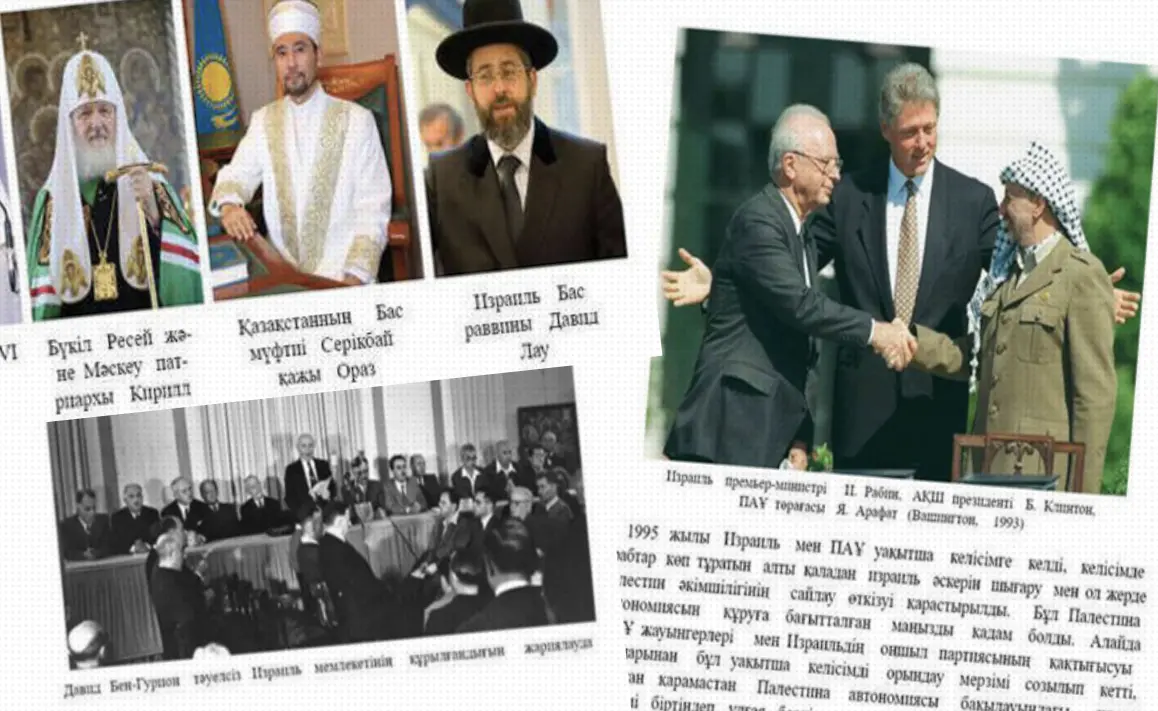
Coverage of the Arab-Israeli conflict in the textbooks is limited but balanced, addressing its historical roots and current complexity without promoting either side. This reflects Uzbekistan's neutrality and its pursuit of peaceful relations with both Arab nations and Israel. The conflict is presented from the 1947 UN resolution onward, with an emphasis on peace negotiations, particularly the Oslo Accords and the assassination of former Prime Minister Yitzhak Rabin by a "Jewish fanatic." Radical Islamist organizations, including Hamas, Islamic Jihad, and Hezbollah, are also discussed, with an emphasis that these organizations are banned in Uzbekistan. The Oslo Accords and the Palestinian National Authority are mentioned in a positive light. It is interesting to note that the textbooks do not identify Jerusalem as the capital of Israel, using the Arabic and Russian names for the city; Tel Aviv is mentioned as Israel's capital, in line with Soviet-era practice. Israel's involvement in regional conflicts is addressed superficially, with no mention of peace treaties with Egypt and Jordan.
Kazakhstan
Kazakhstani textbooks recognize Judaism as one of the world religions, providing basic information about its origins, beliefs, and practices alongside Islam and Christianity. The contribution of Jews to world culture and religious thought is noted, including references to texts such as the Tanakh and the Talmud. Religious reforms in Judaism are discussed in the context of modernization, depicting the religion as a living tradition influenced by social and political processes.
Despite this, the philosophical aspects and historical events related to Judaism are frequently simplified or distorted; for example, the concept of the "chosenness" of the Jews is misrepresented without context, and the term "Palestine" is used incorrectly when describing the origins of Judaism. Relying on a Christian narrative, Jewish priests are presented as responsible for the persecution of Jesus, with no mention of his Jewish origin.
On the other hand, the textbooks adopt a balanced stance on issues of religious extremism, viewing radicalism as a negative contemporary phenomenon that can lead to "terror," while distinguishing it from religious conservatism.
In modern history textbooks, Jews are recognized as victims of genocide during World War II. Antisemitism is mentioned only superficially—in the context of broader historical or political events, without deep analysis of its causes, historical development, or contemporary manifestations. The textbooks focus on the contributions of the USSR and Kazakhstan to the Victory, glorifying figures like General Baurzhan Momyshuly and civilian efforts, while giving little attention to the Holocaust. Key concepts and sites associated with the Holocaust, such as "ghetto," "Auschwitz," and "extermination camps," are absent, leading to an incomplete understanding of the scale of the genocide. The term "Holocaust" is not used; instead, generalized terms like "mass murder" or "genocide" are applied, which dilutes the uniqueness of the Nazi extermination of the Jews.
The depiction of Israel in the textbooks varies: world history and geography textbooks for grades 10–11 provide a more balanced view, whereas history textbooks for grades 8–9 and Kazakh language textbooks for grade 9 contain inaccuracies and demonstrate an anti-Israel bias. Balanced textbooks cover the 1947 UN partition plan, peace negotiations, and the role of both Israeli and Palestinian extremists (such as Hamas) in undermining peace processes. The conflict is presented as one of numerous unresolved global disputes, facilitating an objective perception and preventing bias or disproportionate focus on the topic. The desire of the Jewish people to restore their cultural identity after the establishment of the State of Israel in 1948 is emphasized. In one example, the revival of Hebrew is presented as a positive parallel to efforts to revive the Kazakh language. The Jewish connection to Jerusalem is recognized through the mention that King Solomon, son of King David, built a temple there in the 10th century BCE in honor of the God Yahweh.
Educational assignments on the topic of the conflict are designed to develop critical thinking and treat the Palestinian-Israeli conflict as one of many global disputes. The textbooks recognize the Palestinian aspiration for self-determination, though in some instances, it is presented through a post-colonial lens. The conflict is framed as geopolitical rather than solely religious, fostering a secular and pluralistic view of global conflicts. However, some textbooks exaggerate the scale of the conflict, calling it "the longest in the world," which creates an imbalance. In other textbooks, the emphasis is placed on aggression by Israel, focusing on the "occupation," while downplaying violence and incitement by Palestinian Arabs.
In conclusion, it is evident that school textbooks reflect the day-to-day politics of these republics, which is not surprising. This is primarily expressed in relation to instilling interfaith tolerance and multiculturalism, which are key priorities in education. Topics related to the modern history of the region also bear direct echoes of politics. It is also telling that in certain aspects, textbooks in the national languages differed slightly in phrasing from those in Russian. As noted above, it was a considerable surprise to the author that topics related to Judaism, Jews, and the State of Israel have any place at all in the educational systems of these republics.
Despite all shortcomings, the material on Jews and Israel in the school textbooks of both countries is generally presented in a positive or neutral light. The misunderstandings and minor inaccuracies identified in our study will not be difficult to correct. This issue can be raised by local and international Jewish organizations. It is reasonable to assume that given the presence of full-scale diplomatic relations with these republics and all other Central Asian states, as well as Israel's friendly relations with most post-Soviet Central Asian nations, a call for a respectful dialogue on this topic will be met with understanding."
The views expressed by the experts do not necessarily reflect the official position of the Institute for Euro-Asian Jewish Studies or the Euro-Asian Jewish Congress.
