
This is an automated translation and may contain inaccuracies. For citation purposes, please refer to the original Russian version.
Editor's Foreword
It is widely believed that with the collapse of the USSR and the cessation of anti-Jewish policies and discriminatory practices, the post-Soviet space became a "continent of safety" in terms of manifestations of "accentuated" antisemitism. In any case, this is the perception when compared to a number of Western and Middle Eastern countries. Research over various years has shown that in the collective consciousness of citizens in almost all post-Soviet countries, Jews, unlike during the era of stagnation, ceased to occupy the position of the "primary internal enemy"[1].
Nevertheless, antisemitism, at least in several successor states of the Soviet empire, has not disappeared. It occasionally manifests in incidents of antisemitic violence, vandalism against synagogues and other Jewish sites, and particularly in hate speech and the dissemination of antisemitic narratives in speeches by politicians and public figures, as well as in the media and social networks. However, anti-Israel and antisemitic sentiments, which seemingly belonged to the Soviet past, have returned with full force following the start of the IDF operation against the Palestinian Islamist terrorist enclave and other Iranian proxies.
For instance, according to "The State of Antisemitism in 2021" report, prepared by the Jewish Agency (JAFI) and the World Zionist Organization (WZO), nearly 50% of global antisemitic incidents occurred in Europe, and approximately 30% in the United States; notably, nine out of the twenty most high-profile antisemitic incidents of that period took place in Western nations. Meanwhile, post-Soviet countries were not featured on the list[2]. Yet, by the end of 2023, according to a new report from these organizations and Israel's Ministry of Diaspora Affairs, the situation had shifted dramatically. This time, out of the ten most severe antisemitic incidents globally, two occurred within the territory of the former Soviet Union: in Russian Dagestan (5th place) and in Yerevan, the capital of Armenia (9th place). Overall, according to the report's authors, Russia, Belarus, Armenia, and post-Soviet Central Asia witnessed the highest overall increase in antisemitic activity, particularly in connection with the war in the Middle East[3].
This rapid metamorphosis of public sentiment in these countries, occurring virtually "overnight," suggests the realization of a scenario that sociologists, noting the persistent latency of antisemitic attitudes in the post-Soviet years, previously deemed highly unlikely. It is important to note, however, that several other post-Soviet nations have managed to avoid the reincarnation or adoption of this new form of modern antisemitism.
Georgia can confidently be placed in this latter, far more honorable category. Reflecting on the reasons why antisemitism in this country—as well as in neighboring Azerbaijan—is practically non-existent in public discourse and remains extremely rare[4] (and is immediately and strongly condemned[5]) in political and religious circles, observers point to a high level of tolerance among the population amidst ethnic and religious diversity, and the traditional absence of antisemitic demand within the Georgian nation and its elites. For instance, speaking at the "Friends of Zion" award ceremony in Jerusalem in January 2020, President of Georgia Salome Zourabichvili emphasized that while the absence of antisemitism in Georgia is not a source of pride in itself, Georgians can be proud of the fact that they have always fully embraced the Jewish community as an integral part of their shared nation[6].
“In Tbilisi, which was home to a large Jewish community until the 1970s, it is not uncommon to meet Israeli tourists in summer,” confirm prominent French investigative journalist Clément Girardot and anthropologist Yoann Morvan, who visited Tbilisi in the summer of 2024. “Some of them wear skullcaps and experience no hostility, if not indeed a certain friendliness. Positive attitudes toward Jews and Israel are found not only among the political and economic elite, but also in Georgian public opinion.”[7]
The following article by Dodo Chikvashvili, a prominent Israeli and Georgian biologist and biochemist, professor at the Faculty of Medicine of Tel Aviv University, and member of the Georgian Academy of Ecology, serves as another important illustration of the above.
Prof. Vladimir (Zeev) Khanin, Academic Director of the Institute for Euro-Asian Jewish Studies
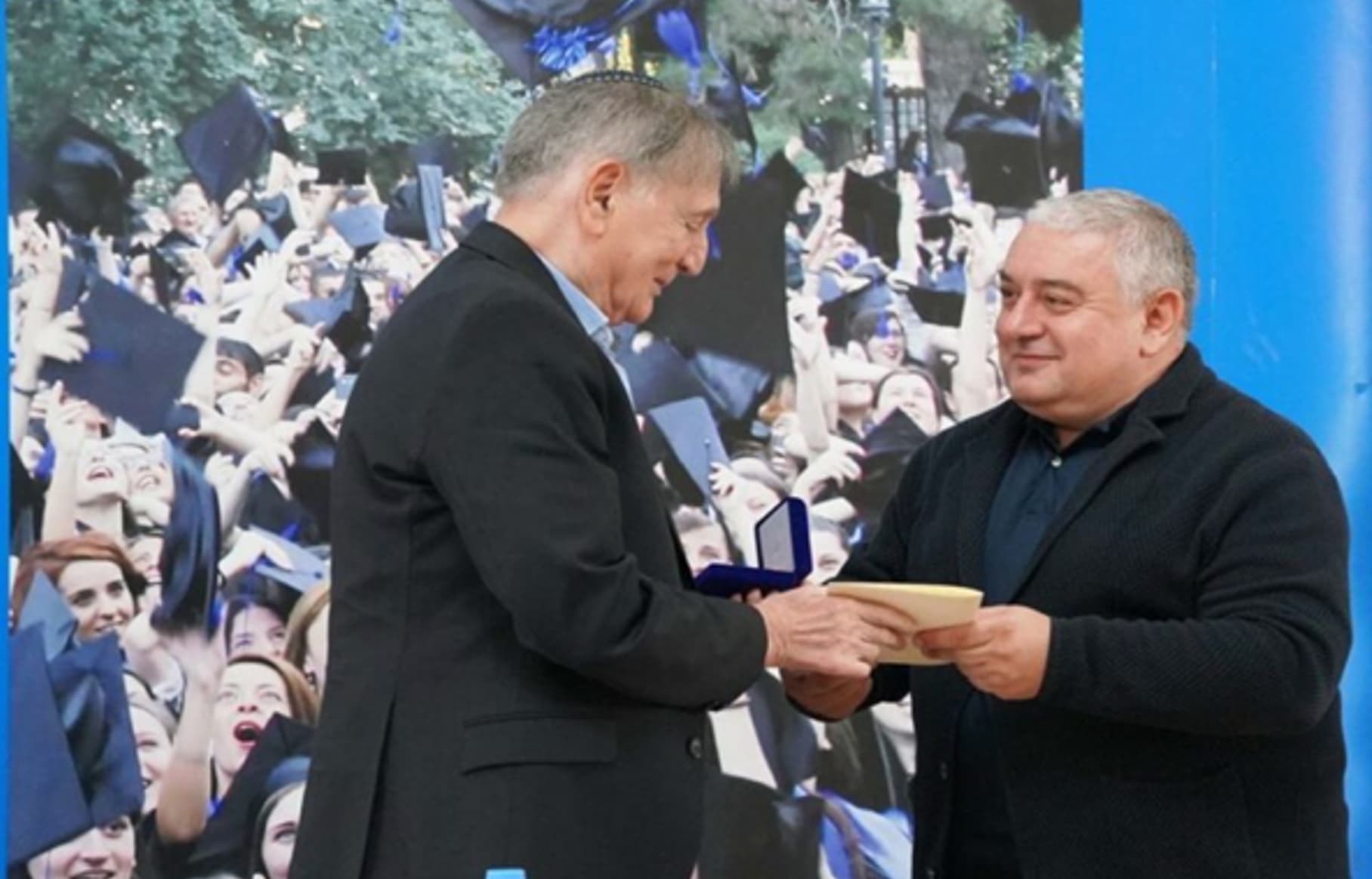
On September 10, 2025, an interdisciplinary scientific conference dedicated to the work of the renowned writer, scholar of Jewish philosophy, and translator Shalom David (Davitashvili) was solemnly opened at Tbilisi State University. Organized by the Ivane Javakhishvili Tbilisi State University, the Georgian National Academy of Sciences, and the David Baazov Museum of the History of Jews of Georgia and Georgian-Jewish Relations, the event served as a symbolic bridge demonstrating once again the centuries-old friendship between the Georgian and Jewish peoples. At the opening ceremony, the Rector of TSU, Academician Jaba Samushia, presented Shalom David with the university's gold medal for his outstanding contribution to the development of Georgian-Jewish relations: “Shalom David's contribution to strengthening relations between the Georgian and Jewish peoples is immeasurable.
His contribution to the study of Georgian-Jewish relations is profound. He has dedicated his entire life to this cause. Georgian-Jewish relations are built on individuals like him,” Jaba Samushia remarked. Darejan Tvaltvadze, Dean of the Faculty of Humanities at TSU, reminded the audience of Shalom David's journey, his academic contributions, and his legacy. “Shalom David is a person who has succeeded in harmoniously bridging two worlds—Georgian and Jewish culture. He is a public figure whose work has left a significant mark not only on modern life in Israel but also in Georgia. His legacy belongs not only to the past but to the future. He studied Jewish philosophy, deeply understood biblical texts, yet remained a Georgian Jew, true to his roots.
“Through his contribution to bringing Georgian and Jewish cultures closer together, Mr. Shalom has proven that spirituality, science, and culture know no borders,” Darejan Tvaltvadze said. She expressed gratitude to the organizers and specifically noted the contribution of Associate Professor Ekaterine Navrozashvili, Head of the Scientific Research and Development Service of the Faculty of Humanities at TSU, in organizing the various events dedicated to Shalom David. Shalom David, guest of honor at Tbilisi State University, expressed his sincere gratitude for the event: “The friendship between the Georgian and Jewish peoples, which has existed for 26 centuries, cannot be confined within stereotypical, outdated, pseudo-national relations. It does not even submit to the laws of social development. Name another country where Jews lived where such relationships existed. This award, presented by the university, is not mine alone; it is an award dedicated to the Jewish people,” he noted. During the event, Shalom David delivered a public lecture entitled “Points of Contact Between the Bible and Modern Science.” Parallel to the scientific sessions, an exhibition opened at the TSU Museum, displaying archival materials detailing the life of Shalom David, his personal belongings, and his scientific legacy. The exhibition was adorned with works by Georgian artist Gia Gugushvili. As part of the events honoring Shalom David, the XII Scientific Student Conference on “Current Issues in Translation and Literary Relations” was also held.
The friendship between Jews and Georgians stands as an example of how human connections can transcend prejudice and political circumstances, even during times of heightened antisemitism. In Georgia, Jews did not experience the mass pogroms that occurred in other parts of the Russian Empire and Europe. Many observers have noted that Georgians treated the Jewish religion and culture with respect. Antisemitism did not take root in Georgia—neither on religious nor on ethnic grounds. The Jewish community followed the wisdom of the Prophet Jeremiah (a passage based on Jeremiah 29:7): “And seek the peace of the city whither I have caused you to be carried away captives, and pray unto the Lord for it: for in the peace thereof shall ye have peace.” These tolerant relations became the prerequisite for the initiation of the Aliyah of the 1970s, as described in Prof. Z. Khanin's article “The Aliyah of the 70s and its Legacy: On the 50th Anniversary of the Letter of the Georgian Jews,” which rightly notes that it became “the starting point of the first post-war mass Jewish emigration from the USSR and repatriation to Israel.” The petition addressed to the UN Secretary-General, signed by 531 Georgian Jews, “broke the dam” and shattered the “Iron Curtain”[8].
Analyzing the life path of Shalom David—from Georgia to Israel—it is easy to see that he is a figure who truly commands respect. Shalom David was born into the family of Rabbi Immanuel, a spiritual leader of Georgian Jews. From his youth, he demonstrated an exceptional passion for learning. In 1972, while studying at the Faculty of Law of Tbilisi State University, he emigrated to Israel, where he subsequently studied philosophy at Bar-Ilan University, specializing in Jewish studies. It was here that his intellectual and public activities began.
Shalom David's first step toward unifying the Georgian diaspora was the publication of the journal "Voice of Judaism" (1972–1985), which reached thousands of readers. Later, under his editorship, the Georgian-language newspaper "Moambe" (1988–1996) was published. It was on his initiative that the Union of Writers of Georgia was founded, with him elected as its first chairman. Shalom David also dedicated many years to public service: he served as editor and broadcaster for the "Kol Yisrael" radio station (1977–1982), advisor to the Israeli Minister of Religious Affairs, and subsequently to the Minister of Culture and Education (1987–1995), member of the municipal administration (1995–2002), and Deputy Mayor of Holon (2004–2008). Between 1982 and 1984, he lectured in Europe and the Americas. Over many years, he frequently visited Tbilisi State University, lecturing to students and faculty. Shalom David's unique translations made the works of ancient philosophers, medieval Jewish poetry, canonical prayers, and biblical texts accessible in the Georgian language. Of particular significance is the illustrated Georgian edition of the Torah, published by the Jewish Cultural Center of Georgia in 1996, translated and edited by Shalom David.
The academic community noted that this was not merely a translation, but a cultural milestone that brought centuries of knowledge accumulated in the Georgian language to life. The work of Shalom David does not belong to the past—it enriches the present and points the way to the future. In 2003, he was elected Deputy Co-Chairman of the World Congress of Georgian Jews and Head of the Commission for Education and Historical Heritage. Today, he is an honorary citizen of Georgia, and his legacy will forever remain in the social and cultural history of Israel and Georgia as a symbol of friendship enduring through the centuries.
Caring for another's land becomes a concern for one's own destiny—a universal message relevant for all times.
[1] See: Antisemitism, Tolerance and Historical Memory in the Post-Soviet Space. Series of Scientific and Analytical Reports, Issue No. 4 (October 2021) / Ed. Haim Ben Yakov. Tel Aviv and Herzliya: Institute for Euro-Asian Jewish Studies (IEAJS) and the Goldstein-Goren Diaspora Research Center, Tel Aviv University, 2021
[2] The State of Antisemitism in 2021. Jerusalem: the Jewish Agency for Israel and the WZO Department for Combatting Antisemitism & Enhancing Resilience, 2022, pp. 4, 19. https://www.gov.il/BlobFolder/news/wzo24012022/en/file_2021%20report-final.pdf
[3] Antisemitism 2023. Submitted to the Government of Israel in Commemoration of the International Holocaust Remembrance Day, With special reference to the “Swords of Iron” War”. Jerusalem: Ministry for the Diaspora Affairs, WZO and JAFI, January 2024, p. 99.
[4] Shota Kincha, “More antisemitic sermons from Georgian Orthodox clergy,” OC Media, January 8, 2021 https://oc-media.org/ru/ocherednye-antisemitskie-propovedi-gruzinskogo-pravoslavnogo-dukhovenstva/; “TDI considers the antisemitic sermon of the GOC Metropolitan highly alarming,” Georgia On-line, 28.12.2020, https://www.apsny.ge/2020/soc/1609208280.php
[5] See: “Ambassador of Israel urges Georgian authorities to condemn antisemitic statements by clergy,” News-Georgia, January 9, 2021 https://www.newsgeorgia.ge/посол-израиля-призывал-власти-грузии
[6] “President of Georgia receives highest award from the ‘Friends of Zion Organization’,” Sputnik Georgia, 22.01.2020
[7] Clément Girardot and Yoann Morvan, “On the path of the Georgian Jews: from symbiosis to the great exodus”, K. Jews, Europe, the 21st Century, 11 July 2024 https://k-larevue.com/en/georgia/?utm_campaign=EN%20news%20%23239&utm_medium=email&utm_source=Mailjet
[8] Zeev Khanin, “The Aliyah of the 70s and its Legacy: On the 50th Anniversary of the Letter of the Georgian Jews,” Euro-Asian Jewish (EAJ) Policy Papers, No 25 (6 September 2019) https://institute.eajc.org/eajpp-25/
The views expressed by the experts do not necessarily reflect the official position of the Institute for Euro-Asian Jewish Studies or the Euro-Asian Jewish Congress.
