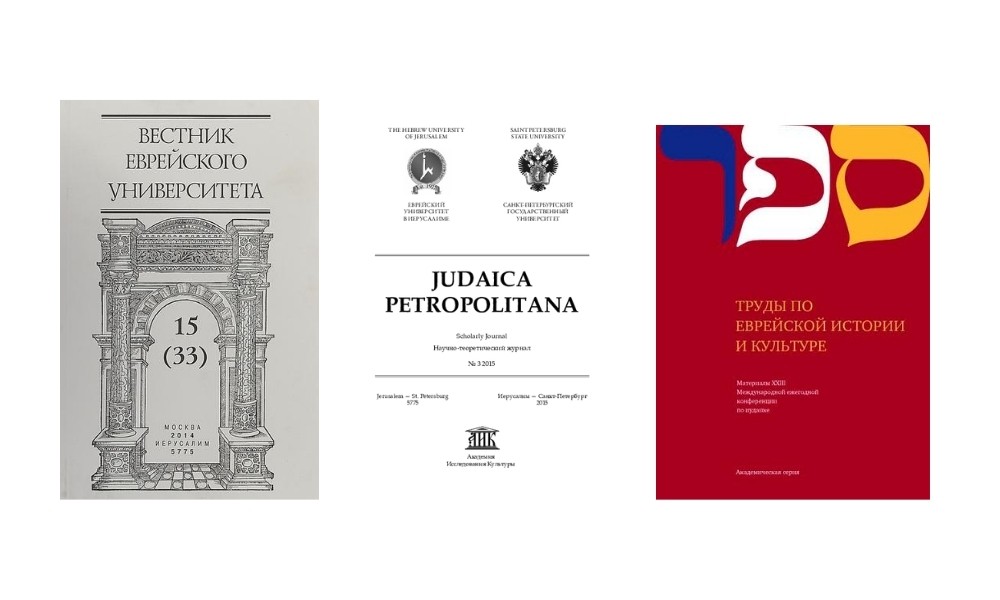
This is an automated translation and may contain inaccuracies. For citation purposes, please refer to the original Russian version.
Against the backdrop of discussions concerning the role of Jewish media in post-Soviet countries, which periodically unfold in professional publications (including the journal of the Institute for Euro-Asian Jewish Studies)[1] and on social networks, it is pertinent to examine a distinct aspect of this topic—namely, academic periodicals. Although several authors have partially assessed the progress of Jewish studies in the post-Soviet period[2], the role of academic journals in the establishment of Jewish studies in the former USSR remains understudied, despite the fact that some publications have existed for nearly 30 years, with notable success.
The objective of this article is to provide a brief overview of the situation within the segment of Jewish academic periodicals. This study does not cover serial publications, such as the "Proceedings in Jewish Studies" of the St. Petersburg Institute of Jewish Studies, the "Proceedings of the Department of Jewish Studies" (only two volumes have been published so far, in 2015 and 2018), the materials of the annual conferences of the Sefer Center, or collections published following conferences organized by the Kyiv Institute of Jewish Studies. All of these, particularly the publications of the Sefer Center, have exerted a profound influence on the formation of the academic community and Jewish identity[3], serving as a distinctive cross-section of the development of post-Soviet Jewish studies from the 1990s through the 2010s. These serial publications also represent a specific form of academic and communal Jewish activity that undoubtedly merits separate consideration.
It is hoped that this review is highly objective, though personal assessments are inevitable, given that the author has been involved in editing a Jewish academic journal for 10 years and remains closely connected to the academic sphere.
When analyzing academic periodicals, three key points must be noted. First, any academic journal, on one hand, reflects the state of the field and, on the other, shapes trends within its respective area of research. Second, if a journal is established from scratch (rather than being a reincarnation of a Soviet-era publication), it represents a monumental effort in finding a niche, developing an editorial policy, securing funding, and organizing the work of the editorial board. Third, such publications are often highly personalized, driven by a single individual or a relatively small group of enthusiasts. For thirty years, these journals have defined trends in Jewish scholarship within various territories, provided a platform for academic debate, and brought together like-minded researchers.
Four stages can be identified in the development of post-Soviet academic "Jewish" periodicals.
Stage 1: The First Half of the 1990s
Established in 1992, the "Bulletin of the Jewish University in Moscow" aspired to become the "coordinating center" of post-Soviet Jewish studies. The journal was published regularly, remaining for a long time the sole venue for publishing research on Jewish history and culture, and serving as a gateway to Jewish scholarship. In 1998, the publication was renamed the "Bulletin of the Jewish University: History. Culture. Civilization," and its format was slightly modified to increase the proportion of translated works by Israeli authors.
These shifts in editorial policy were driven by the involvement of the Hebrew University of Jerusalem and the Center for Jewish Studies and Jewish Civilization of the Institute of Asian and African Studies at Moscow State University, established in the same year, 1998. From the mid-2000s, the journal was published irregularly, and in 2011, it ceased publication entirely. The history of this publication has already been documented by the Russian researcher S. Charny[4], and there is currently little to add. In any case, between 1992 and 2011, the "Bulletin" reflected the state of academic Jewish studies across the former USSR.[5] Gradually, as Jewish studies established itself as an independent academic discipline, other academic publications emerged in the post-Soviet space.
Stage 2: The Late 1990s to the 2000s
The boom in Jewish academic periodicals occurred at the turn of the 1990s and 2000s. This period of growth was facilitated by several factors: the intensification of Russian-Israeli relations, including in the academic sphere; the enthusiasm of researchers and the interest of undergraduate and postgraduate students in Jewish studies; the influx of donor funding; and the general atmosphere generated by regular conferences, schools, internships, and other educational projects of the Sefer Center. All of this set Jewish studies apart from other regional or country-specific fields of study[6]; for instance, no such boom was observed in Indology or Iranian studies.
Jewish leaders formulated a theory according to which schools and universities were to be the key to the revival of the Jewish community in secular post-Soviet society[7], which also stimulated the development of academic scholarship. Periodicals, including academic ones, were viewed as a cornerstone of the community. It should be noted that this theory still prevails in the Jewish movement in post-Soviet Russia and is even supported by empirical evidence[8].
Predictably, the number of Jewish academic publications grew under these conditions. Against this background, general academic journals also devoted attention to Jewish topics, including the Russian publications "Vostok (Oriens). Afro-Asian Societies: History and Modernity," "Zhivaya Starina," and "Diaspory," the Moldovan "Revista de etnologie şi culturologie," as well as popular-science and literary Jewish publications (the Moscow-based "Lechaim," the Kyiv-based "Yehupets," etc.). This demonstrated an interest in Jewish scholarship not only among academics but also within the wider public. It was during this period that a trend emerged which continues today: the endeavor to integrate Jewish history and culture into a broader context, an approach favored by the authorities of post-Soviet states, as well as by researchers and the general public in those countries.
This process encompassed not only Russia but also other states of the former USSR, where independent Jewish academic publications began to appear. For instance, in 1997, the collection "Jews of Belarus: History and Culture" began publication. After six volumes (the last published in 2001), the publication ceased due to a lack of funding. Between 2002 and 2004, the publicist and Jewish movement activist Y. Basin compiled the collections "Belarus in the 20th Century," and in 2007, in collaboration with the Belarusian historian I. Kuznetsov, published three volumes of materials titled "Repressive Policies of the Soviet Regime in Belarus." Jewish themes occupied a significant place in these serial publications.
In Ukraine, where Jewish studies experienced a particular surge in the 1990s and 2000s, a general academic journal of Jewish studies was not established at that time. Instead, highly specialized academic periodicals were published, such as "Holocaust and Modernity: Studies in Ukraine and the World" (published by the Ukrainian Center for Holocaust Studies from 2005 to the present) and "Problems of Holocaust History: Ukrainian Dimension," published by the Tkuma Ukrainian Institute for Holocaust Studies (the first issue appeared in 2002, with eight issues and an English-language digest published to date).
Special mention should be made of the journal/collection "Tirosh: Studies in Judaica," established under the publishing program of the Sefer Center (first published in 1997 as a collection of materials from the First CIS Youth Conference on Jewish Studies). Since 2018, the collection has functioned as a fully-fledged academic periodical under the title "Tirosh: Studies in Judaica, Slavic, and Oriental Studies." The journal was originally positioned as a publication for young scholars, which partly ensured its success. In any case, it served as a launching pad for many, if not most, researchers currently active in the field of Jewish and Middle Eastern studies. It is worth noting another positive feature of this publication: the youth collection of the Sefer Center has been published regularly throughout all these years.
Another attempt to establish a comprehensive academic journal of Jewish studies was made by the Lithuanian Center for the Study of the Culture and History of East European Jews. From 2006, the Center published several issues of the journal "Pinkas" (in English), but publication was suspended in 2010.
Difficulties in publishing academic journals began in the second half of the 2000s. This trend was undoubtedly characteristic of Central and Eastern Europe as a whole. For instance, the Central European University publication "Jewish Studies at the CEU" appeared very infrequently, despite being designated as an annual. In 2008, the Hebrew University of Jerusalem's journal "Jews in Russia and Eastern Europe" ceased publication. The "Bulletin of the Jewish University," which remained the primary academic periodical on Jewish studies in the post-Soviet space, began to appear irregularly. In Belarus, the seventh volume of the collection "Jews of Belarus: History and Culture" was never published, although the materials were nearly compiled; likewise, no collections compiled by Y. Basin were published after 2007. After 2010, "Pinkas" ceased to exist. On the whole, only the aforementioned Ukrainian journals covering various aspects of Holocaust history—"Holocaust and Modernity: Studies in Ukraine and the World" and "Problems of Holocaust History: Ukrainian Dimension"—were published regularly.
Stage 3: The Late 2000s to the First Half of the 2010s
In this situation, scholars in Jewish studies recognized the need for new specialized publications. In 2008, the Ukrainian art historian Y. Kotlyar began editing special issues of the "Bulletin of the Kharkiv State Academy of Design and Arts" ("Visnyk Kharkivskoi derzhavnoi akademii dyzainu i mystetstv"), which published materials on Jewish art. In 2010–2011, he successfully published issues dedicated entirely to Jewish art in Ukraine. In 2009, the collection "Mizreh: Jewish Studies in the Far East" began publication in Birobidzhan (edited by B. Kotlerman, with two issues known to have been published in 2009 and 2011). In 2010, the author established the annual "Tsaytshrift/Časopis" ("The Journal," or "The Periodical," by analogy with the Yiddish publication that appeared in 1926–1931 under the auspices of the Jewish Department/Sector of the Belarusian Academy of Sciences), which continues to exist today. From 2011, the "Collections of Scientific Works of the Institute of Jewish Studies" were published in Moldova (now discontinued); in 2012, the Kyiv-Mohyla Academy published the first issue of the journal "Judaica Ukrainica" (which since 2015 has been the official organ of the Ukrainian Association for Jewish Studies, with eight issues published to date); in 2013, the Department of Jewish Culture at St. Petersburg University, with the support of the Hebrew University of Jerusalem, published the first issue of the journal "Judaica Petropolitana" ("St. Petersburg Jewish Studies").
In February 2013, at the XX International Conference on Jewish Studies in Moscow, the Sefer Center and the editorial board of the annual "Tsaytshrift/Časopis" hosted a roundtable for editors of Jewish academic periodicals, attempting to gather representatives from all publications covering Jewish topics. The roundtable was attended by editors of the following publications: "Bulletin of the Jewish University" (Moscow), "Bulletin of the Kharkiv State Academy of Design and Arts. Oriental Studies" (Kharkiv), "Diaspory" (Moscow), "Zhivaya Starina" (Moscow), "Narod Knigi v Mire Knig" (St. Petersburg), "Archive of Jewish History" (Moscow), "Euro-Asian Jewish Yearbook" (Moscow–Kyiv), "Pinkas" (Vilnius), "Tsaytshrift/Časopis" (Vilnius), as well as the Swedish journal "Central Asia and the Caucasus," the Polish "Cwiszn," the "Jerusalem Almanac," the "Tirosh" collections, the annual collections of the Sefer Center, and serial publications—the Moscow-based "Judaica Rossica" and the St. Petersburg-based "Proceedings in Jewish Studies."
The participants of the meeting confirmed the demand for Jewish academic periodicals, as well as the necessity for independent academic publications—free from dependence on grants or the whims of sponsors and publishing houses. This implies that such journals should be published by academic institutions (universities and research institutes).
Stage 4: From the Mid-2010s to the Present
Time has passed, but the need for academic periodicals in Jewish studies remains, even though the field itself has experienced a crisis (the Ukrainian researcher V. Likhachev even raised the question of a potential "systemic error" in the development of Jewish studies[9]) following the boom of the 1990s and 2000s. The causes of this crisis include problems common to post-Soviet countries: the stagnation of the humanities, which have found little support from the state, leading to both an internal outflow of personnel from academic research to other sectors (such as business) and a "brain drain" abroad. These processes in Jewish studies were further exacerbated by a shortage of donor funding, which became apparent after the 2008 global economic crisis.
There is another factor that has influenced the current state of Jewish studies in post-Soviet countries: the international crisis of 2014 isolated Ukrainian researchers from their Russian counterparts. This resulted in the operation of two separate centers of Jewish studies in the post-Soviet space with limited connection to each other—one in Russia and one in Ukraine—whereas prior to 2014, professional contact had been highly intensive. (This represents the author's personal observation, though few would deny the impact of these events on the current state of Jewish studies).
One consequence of these crisis processes has been a reduction in the number of scholars specializing in "Jewish" disciplines. Nevertheless, academic journals have provided a platform for those researchers who chose to remain in the field. Thus, while the system of academic institutions and publications in Jewish studies built since the 1990s has partially fractured since the mid-2010s, academic Jewish journals continue to help support and preserve this structure.
Currently, seven academic journals dedicated exclusively to Jewish topics continue to be published: "Tirosh: Studies in Judaica, Slavic, and Oriental Studies" (since 1997) and the "Judaic-Slavic Journal" established in 2018 (both published by the Sefer Center and the Institute of Slavic Studies of the Russian Academy of Sciences in Moscow), "Judaica Petropolitana" (St. Petersburg), "Judaica Ukrainica," "Holocaust and Modernity: Studies in Ukraine and the World," "Problems of Holocaust History: Ukrainian Dimension" (in Ukraine), and the Belarusian "Tsaytshrift/Časopis" (in Vilnius). All of these possess an International Standard Serial Number (ISSN), and submitted manuscripts undergo peer review; the Russian publications and the Belarusian-Lithuanian "Tsaytshrift/Časopis" are indexed in various academic databases. Furthermore, almost all of these journals are openly accessible on the Internet. When these four indicators are present, one can speak of a fully functional academic journal. (The author identifies accessibility as a primary indicator of an academic publication: since scholars in post-Soviet countries are often underfunded, keeping track of colleagues' work is significantly easier when open access to information is provided).
Evaluating the outcomes of the development of Jewish academic periodicals, we may add (though this is the author's subjective view) that its finest achievements have been the Moscow-based "Bulletin of the Jewish University," which at its inception was the only internationally recognized academic journal in this field in the Russian language, as well as "Tirosh," which paved the way for young researchers; the Ukrainian "Bulletin of the Kharkiv State Academy of Design and Arts. Oriental Studies" (published in 2008–2011) edited by Y. Kotlyar, and the Lithuanian "Pinkas," published in English—the language of modern science. Specialists in the history of the Holocaust also highly regard the Ukrainian publications "Holocaust and Modernity" and "Problems of Holocaust History: Ukrainian Dimension." It is still too early to draw conclusions regarding the Moscow-based "Judaic-Slavic Journal," as only two issues have been published so far. The St. Petersburg-based "Judaica Petropolitana" devotes significant space to specialized topics in Jewish philosophy (a review of its first issue was published in "Tsaytshrift/Časopis").[10]
"Judaica Ukrainica" has become a journal that has consolidated the fragmented efforts of Ukrainian researchers, a function that has become particularly relevant since 2014. However, this journal—like the other two highly specialized publications dedicated to the Holocaust—focuses primarily on Ukrainian-Jewish issues in all their diversity, which restricts both the pool of authors and the range of topics. Regarding the Belarusian-Lithuanian annual "Tsaytshrift/Časopis," the author will, for the time being, modestly refrain from comment.
In any event, Jewish academic journals help to preserve the structure of Jewish studies as a scientific and teaching discipline in higher education, which was established in the post-Soviet countries during the 1990s. Existing publications in the field of Jewish studies reflect the current state of the discipline—a focus on issues of immediate relevance to a specific region or a particular academic institution.
Modern Challenges of Jewish Academic Periodicals
A colleague with whom the author discussed a draft and some conclusions of this article raised a valid question: what are the potential trajectories for the development of the situation within the framework of this topic? In this connection, it is appropriate to outline the main problems faced by, presumably, all editorial boards of Jewish academic journals.
Problem 1: Funding. It is entirely obvious that no publication can exist without funding. While the possibility of obtaining grants from major Jewish foundations remains, international donors today rarely and reluctantly fund academic publications.
The idea from the late 1980s and early 1990s of turning schools, universities, and research (or rather, research-organizational) institutions into centers of Jewish communities continues to be implemented and will likely persist for some time[11]. Since several post-Soviet Jewish figures became advocates of this idea, funding from the community could hypothetically be anticipated. However, first, communities do not always possess the necessary resources, as they themselves rely heavily on donor contributions, and second, it is impractical for a community to support the publication of academic journals—such projects offer no "market" return, as the humanities (and social sciences) are inherently unprofitable. Occasionally, an academic publication may transition into a popular-science or literary format. This is neither positive nor negative; it is simply a different genre.
Consequently, the only viable option remains the publication of an academic journal under the auspices of a university or research institute, with corresponding funding from these institutions. The purpose of academic periodicals is to present research results (whether preliminary or final) in a manner accepted by the scientific community—other researchers in Jewish studies, scholars working in related fields, the Higher Attestation Commission, and university administrations. All seven publications mentioned above currently fulfill this objective. However, in the post-Soviet context, funding from the state, university, or academic institute can be terminated at any moment.
Problem 2: Scientometrics. In the era of diverse databases, one cannot avoid engaging with scientometrics. It is for this reason that the inclusion of a journal in international databases of academic periodicals is considered a benchmark of a reputable academic journal—implying the publication's accessibility in the West, its citation rate, and to some extent, self-promotion, which is indispensable. At the same time, the author intentionally refrains from citing inclusion in the Web of Science (WoS) and SCOPUS databases as a marker of quality: these databases were originally designed for Western natural sciences and commercial gain, and in the post-Soviet context, they have been transformed into a tool of poor academic management, and in some instances, even a means of marginalizing dissenting voices within the academic community. (Unfortunately, academic and university administrators across the post-Soviet space have overlooked the fact that scholars in the humanities—historians, political scientists, philologists, and orientalists—have always had their own markers of publication prestige, which are far removed from WoS and SCOPUS).
Problem 3: Prospects. Given all of the above, it can only be assumed that the number of Jewish academic journals will decrease over time. The primary reasons include a lack of funding and a general reluctance of post-Soviet states to support Jewish studies (while the situation varies by country, the trends are remarkably similar). Nevertheless, all of the aforementioned academic journals have already secured their place in the history of Jewish academic periodicals in the post-Soviet space.
[1] See, for example, Chernin, V., "The State of Jewish Periodicals and Book Publishing in the Former USSR," Euro-Asian Jewish Policy Papers, No. 33, and Khanin, V., "Are Jewish Publications Needed in the Former USSR: Sociological Aspects," Euro-Asian Jewish Policy Papers, No. 34. See also: Gold, M., "Jewish Journals in the Post-Soviet Space," Euro-Asian Jewish Yearbook — 5765 (2004/2005), Kyiv: Dukh i Litera, 2005, pp. 187-196, and the article by Gold, M., "Jewish Periodicals in the Post-Soviet Space: 30 Years Later" in this volume.
[2] Charny, S., "Late Soviet and Post-Soviet Jewish Studies," Materials of the XI Annual International Interdisciplinary Conference on Jewish Studies: Part 2, Sefer Center for University Teaching of Jewish Civilization, Moscow, 2004, pp. 133-162; Victoria Mochalova, “Jewish studies in Russia in the post-Communist era”, Modern Jewish Studies, 2011, Vol. 10, No. 1, pp. 119-133; Yakovleva, O. and Likhachev, V., "Academic Periodicals in Jewish Studies in the Post-Soviet Space," Euro-Asian Jewish Yearbook — 5764 (2003-2004), Kyiv: Dukh i Litera, 2004; Dzmitry Shavialiou, “Israel, Palestine and Holy Land Studies in the Post-Soviet Territory: Views, Trends, and Prospects”, in: Schapkow, C., Hodl, K. (eds.), Jewish Studies and Israel Studies in the Twenty-First Century: Intersections and Prospects (Lanham, Boulder, NY, London: Lexington Books, 2019), pp. 45-71
[3] On this, see: Baulina, I., Khanin, V., "'Non-Jewish Zionists': The Experience of the CIS and Baltic Countries," Jews of Europe and Asia: State, Heritage, and Prospects: Yearbook: 5779 (2018/2019), Jerusalem, 2019, pp. 234-246
[4] Charny, S., "The Jewish University in Moscow (1991-2009)," Materials of the XVI Annual International Interdisciplinary Conference on Jewish Studies: Part 2, Sefer Center for University Teaching of Jewish Civilization, Moscow, 2009, pp. 490-522
[5] There is an alternative perspective on this matter. For instance, the chairman of the academic council of one of the co-publishers of the Sefer Center's journal, Prof. M. Chlenov, believes that "the journal closed because its management was conducted from Israel, where a different tradition of academic Jewish studies predominated," — Editor's note.
[6] Hofman, S., "On the Activities of the Sefer Center in the Former Soviet Union," Yehudey brit ha-mo’atsot be-ma’avar (Jews of the Soviet Union at the Crossroads), 4(19), [2000], pp. 261-264 (in Hebrew); Fishman, D., "The Revival of Jewish Scholarship in Russia in the 1990s," ibid., pp. 250-260; Charny, S., "Late Soviet and Post-Soviet Jewish Studies"; Mochalova, “Jewish studies in Russia in the Post-communist era”; Shavialiou, “Israel, Palestine and Holy Land Studies in the Post-Soviet Territory” etc. See also the collection of interviews with participants in the Jewish academic revival: Galina Zelenina, "Judaica Two: A Renaissance in Faces" (Moscow: Knizhniki, 2015)
[7] “Russian Scholars Believe Jewish Studies Provide Key to Renewal in Their Homeland”, JTA (Electronic Archive) 23.01.1995, https://www.jta.org/1995/01/23/archive/russian-scholars-believe-jewish-studies-provide-key-to-renewal-in-their-homeland; Semyon Parizhsky, “Jewish Studies in the FSU: From Scholarship to Social, Cultural and Educational Construction, Regeneration and Growth”, in Sh. Wygoda and I. Sorek (Eds.), Educational Eclectics: Essays in memory of Shlomo (Seymour) Fox by Graduates of the Mandel Leadership Institute (Jerusalem: Keter/Mandel Foundation, 2009), pp. 49-97. On the revival of organized Jewish life in late Soviet and post-Soviet times, see, for example: Vladimir (Ze’ev) Khanin (Ed.), “Jewish Politics and Community-Building in the Former Soviet Union” (Jerusalem: Special Issue of Jewish Political Studies Review, Vol 14, No 1-2 (Spring 5762/2002); Ze’ev Khanin and Velvl Chernin, Jewish Identity in the Post-Soviet Countries: Models, Challenges and Prospects, Tel-Aviv: Institute of Euro-Asian Jewish Studies and Center for the Diaspora Studies of Tel-Aviv University, March 2020; Dmitry Shevelyov, "Jewish Communities of Ukraine, Moldova, and Belarus at the Turn of the 1990s and 2000s," Perekrestki: Journal of East European Borderland Studies, 2009, No. 1-2, pp. 21-86, etc.
[8] See the cited work by I. Baulina and Z. Khanin, "'Non-Jewish Zionists': The Experience of the CIS and Baltic Countries," as well as Irina Kopchenova, “Academic Jewish Studies and Secular Jewish Identity in Post-Soviet Russia and the FSU”, in Larissa Remennick and Anna Prashizky, Eds., Formal and Informal Jewish Education: Lessons and Challenges in Israel and in the Diaspora, Ramat-Gan: Bar-Ilan University (Special Issue of the Sociological Papers, Vol. 17, 2012-2013), pp. 122-130
[9] Likhachev, V., "Jewish Studies in Ukraine: Temporary Difficulties or a Systemic Error," Hadashot, No. 3(179), March 2012 (Adar 5772)
[10] See: Tsaytshrift/Časopis, Vol. 9(4), pp. 208-209
[11] See in more detail: Parizhsky, “Jewish Studies in the FSU”; see also: Theodore Friedgut, “The Phoenix Revisited — The Jewish Community of Russia Since Perestroika: A View from Jerusalem”, in Khanin, V. (Z). Ed., Jewish Politics and Community-Building in the Former Soviet Union (Jerusalem: Special Issue of Jewish Political Studies Review, Vol 14, Nos 1-2 (Spring 5762/2002), pp. 47-80
The views expressed by the experts do not necessarily reflect the official position of the Institute for Euro-Asian Jewish Studies or the Euro-Asian Jewish Congress.